
DIY wire rigging terminations for remote cruising repairs
A blue-water skipper in need of replacement wire rigging, whether for an urgent repair or a long-scheduled renewal, might find themselves a long way from rigging workshops, swaging presses or familiar chandlers.
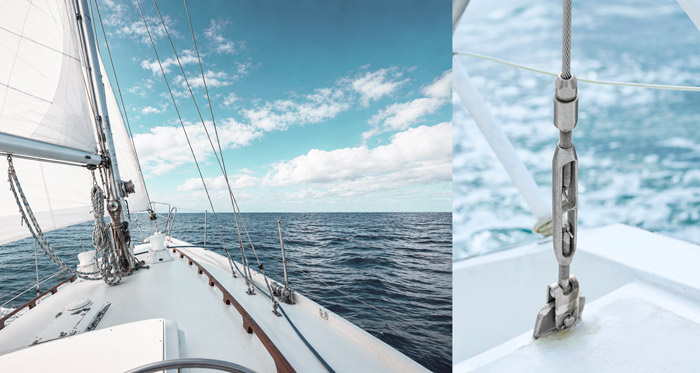
Being so remote from a profusion of wire types and terminations and the experts to fit them should not mean, however, that the rigging work cannot be undertaken.
In these situations, understanding how to combine swaged and DIY stainless wire terminations can turn a complex problem into a manageable one. It allows replacement parts to be ordered with confidence, even when accurate measurements are difficult to confirm in advance.
The challenge of replacing rigging away from home
Wire rigging is commonly manufactured with swaged terminals – solid-metal fittings which are compressed very powerfully around the wire – at both ends.
When replacing a wire in a well-equipped yard, this presents few difficulties: the original stay/shroud can be laid alongside the new one and copied exactly.
Remote locations rarely offer that luxury. Challenges include:
- Limited or no access to swaging equipment
- Inconsistent availability of terminals and wire sizes
- Difficulty confirming final wire length before manufacture
- Pressure to minimise downtime when weather windows matter
A mixed termination approach
Fully swaged replacement wires can be ordered to be shipped out to the boat, but when both ends are swaged in advance, any small measurement error becomes permanent.
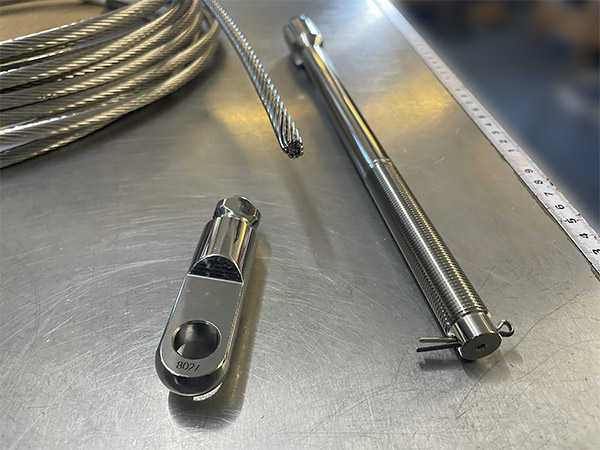
A widely adopted solution is to combine a swaged terminal at one end of the wire with a swageless or compression terminal at the other. The upper termination is factory swaged and the lower is fitted on board.
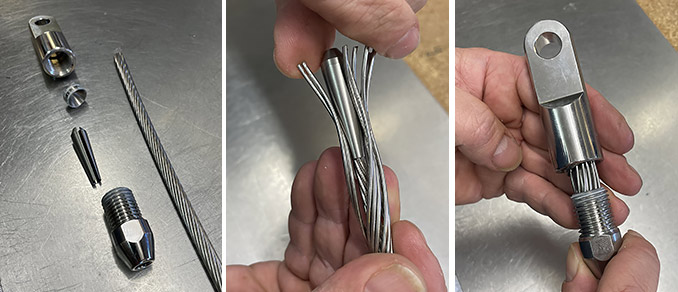
Also known as DIY or Self-Fit Wire Terminals, swageless terminals are designed to be assembled by any competent amateur. The strength is delivered by the clever compression design.
The wire can be supplied slightly overlength, then trimmed precisely to suit the rig before the lower terminal is fitted. This removes much of the risk associated with advance measurement and allows the final length to be set where it actually matters, on the boat.
Do I always need to replace a whole stay or shroud?
A common location for rigging failure is the point at which the wire enters a swage. Movement of the wire here, especially when wire is loose, can cause strands to degrade or break completely. Petersen and Sta-Lok supply fittings which allow you to cut the wire at this location and add DIY terminals, matching the original length. Sta-Lok’s product is an extra-long terminal; Petersen’s is an insert which is added between standard fittings to extend them.
Why mixed termination works well in remote locations
The mixed termination method offers several practical advantages for cruising sailors:
Measurement flexibility
- Final adjustment is carried out at the boat, not in a workshop. This is particularly useful where rig geometry has changed over time or where original measurements are uncertain.
No specialist machinery required
- Mechanical terminals are designed to be assembled using standard hand tools. While accuracy and care are essential, no swaging press is required
Reduced reliance on local supply
- Many cruising destinations have limited access to stainless wire and even fewer stock suitable terminals
Airfreighting mixed-termination rigging
When local availability is uncertain, having wire and terminals sent from a known specialist supplier can be the most reliable option, even when that supplier is thousands of miles away.
Airfreight tends to be the most practical way of sourcing rigging components long-distance, for the following reasons:
- Stainless wire, though often heavy, coils compactly in a way that makes it easy to ship by air
- Airfreight is commonly available to island and remote destinations
- Costs are predictable, if not inexpensive
- Airfreight is usually much faster than shipping by sea. This can be crucial when a weather window is threatening to close
Compression terminals in practice
Mechanical or compression terminals are widely used for standing rigging and are available to suit most common wire sizes and constructions. Two stainless steel brands dominate long term cruising use due to their reliability and broad global adoption: Sta Lok and Petersen.
Both systems are designed to be assembled on board and, when fitted correctly, provide a secure termination suitable for permanent standing rigging, guaranteed to be as strong as the wire. They have been around for a long time, so they are generally well understood by riggers and many cruising sailors.
Key considerations when using these terminals include:
- Matching the terminal exactly to the wire diameter as well as the construction – standard 1×19, compacted strand or flexible 7×19
- Cutting the wire cleanly and squarely
- Following the manufacturer’s assembly instructions carefully
- Inspecting the finished termination thoroughly before loading
While these fittings are intended for DIY installation, they reward care and accuracy. Rushing the process or deviating from the instructions increases the risk of problems later.
Planning ahead
Knowing about the available options, and your requirements, can make a significant difference when problems arise far from home.
It is worth noting:
- Your rigging wire sizes and construction and terminal types
- Which terminations can be assembled on board
- Which components are difficult to source outside major centres
Many marine suppliers publish detailed technical guidance. Familiarising yourself with this information before it is needed enables you to make better decisions under pressure.
A practical option, not a compromise
Using a swaged terminal at one end of a wire and a DIY compression terminal at the other is not a stop gap solution; it is a standard, well-proven method that matches the long-term requirements of long-distance cruising.
For sailors operating far from established marine infrastructure, it offers great flexibility for the renewal and repair of critical parts of the rig. With good preparation and careful assembly, it can turn what might otherwise be a voyage-ending problem into a manageable maintenance task.
Visit JimmyGreen.com to learn more about their products and services.
……………………………..
Related Links:
- Jimmy Green Marine on Noonsite with links to all articles
- About Jimmy Green Marine
- Jimmy Green Marine Standard Rigging
- Worldwide Shipping
………………………………
© 2026 Noonsite. This content was edited by Noonsite. Do not reproduce without permission. All rights reserved.
The opinions expressed in this article are the author’s own and do not reflect the view of Noonsite.com or World Cruising Club.
Find out all news, reports, links and comments posted on Noonsite, plus cruising information from around the world, by subscribing to our FREE monthly newsletter. Go to https://www.noonsite.com/newsletter/.
Leave a comment
You must Login or Register to submit comments.