
In 2001, I revived my interest in boating. It happened because of the following set of circumstances. In 1999 I bought a business and began work as a hydraulic and marine engineer. Effectively apprenticed to one of my staff. Approximately 18 months later my company won a contract to refit a factory ship, fish processing room. It was a Japanese ship transferring to New Zealand’s fishing grounds. The refit started with a contract to build 14 conveyor belts. That project then grew every day for four months and ended four and a half months later when the ship started working in NZ.
I made a bit of money. Nothing major but enough to make me debt free and have a bit left over. It was hard work. Six days a week and no Christmas holiday. Prior to Christmas we had a short break. About three days including a weekend. During that break we arranged a special treat for the Japanese crew. Now imagine what you would want if you were a professional fisherman and had the occasion of a gifted Christmas treat. We took them fishing.
We chartered a local fishing vessel. It wasn’t your average fishing charter vessel. It would be better described as an expensive luxury cruising launch. A fifty six foot long expensive cruising launch. Eighteen Japanese fishermen and ship officers. We had a good days fishing with a good days catch from the Cook Strait. And I fell in love again, with the sea and boats.
I bought myself a little boat….
It was more than 15 years since I had last been boating, when I had sailed my father’s boats. In those 15 years I had learned to fly. I had a half built aeroplane in my garage at home. All that was forgotten. My first love, the sea, was with me again. The names Paladin, Knight Templar and Lactura (my Great Grandfather’s ships) came back into my imagination. Out of Scotland, he (alongside my Great Grandmother) had sailed my home waters, in the 1860s, when trading on the clipper route.
So when our project finished and there was a bit of money available I bought myself a little boat. A thirty eight foot, motor sailor. A Bruce Roberts, Pacific Coast Fisherman. And my life changed.
Joining a delivery crew from Fiji to New Zealand
About two years later while working on another yacht, its owner, Rick Hart, mentioned that he was entering the Auckland – New Zealand to Musket Cove – Fiji race in May. He already had a race crew but needed a second crew to bring the yacht home in July. The plan being to sail to Tonga before returning to New Zealand. Sailing south from Tonga in July was never going to be a pleasant trip. It’s mid winter. Heading for the southern ocean. Battling the gales which sweep through Bass Strait and then let loose into the expanse of the Tasman Sea. It’s New Zealand weather. Consequently there wasn’t a queue waiting to join this return crew. I foolishly said I was interested.
Various problems kept the yacht in Fiji and in July I flew to Nandi, not Tonga, and caught a taxi to Vuda Marina. Picking up some sea sickness tablets on the way. Arriving at Vuda I found a circular bowl marina. It was about 200 meters in diameter, same as today, and was half full of yachts. That might surprise people who have been there recently. At the height of the sailing season – but only half full. Vuda did not get to the overbooked state it is now, until about 2010. The new outer marina did not exist. There was however direct access to the First Landing Resort next door. Vuda’s Boat Shed restaurant/cafe was one of two places to eat and drink.
I walked around the bowl to the yacht Kahukura 11. Said hello to an old friend Phil Berkett, the skipper, and a new friend Alan McLennan as well as a woman – who’s name I cannot remember. I remember her, but not her name. I can recall the other names because I know them much better. I have a memory fault and names just do not stick, unless I hear them often. The older of my two sons once said to me, “Dad, the girl is Rosalind, the big one is David (himself), the little one is Sean, stop calling us “what’s your name.” I made an effort with the children after that and do not think I ever forgot their names again.
A Slow Delivery Passage
My imagination of a delivery passage, (this was my first,) was arrival, one night on board, leave the next day. New Zealand is about 9 -11 days south of Fiji, depending on weather. Southerlies slow you down and at that time of year will likely be the wind for most of the voyage. Racing yacht or not it was not going to be a fast passage.
I did not realise how slow it would be. I hadn’t planned on Phil.
During the race from Auckland, in which Kahukura 11 came last, the yacht had lost its rudder. It was a shaft hung rudder with no bottom support and no skeg attachment. Not an offshore design in my opinion. The rudder fell off approximately 200 miles south of Fiji and they finished the race steering with a drogue running 20 metres behind the yacht. Phil managed to sail Kahukura 11 into the southern Fijian reefs by drogue and get within a mile of Musket Cove before being towed. It was eight weeks later when I arrived. Phil had ordered, waited for, then installed a new rudder, then sailed around the Yasawa Islands for fun before getting Kahukura 11 to Vuda Marina.
Because Phil wasn’t ready to leave I was able to experience the community of sailors at Vuda. One I remember was a 50something Frenchman with a young partner who looked too young. He complained that his stockbroker was not earning him enough money to keep his girlfriend in the lifestyle she was accustomed to.
No hurry to leave
After eight weeks in Fiji, Phil was in no hurry to leave. A state, I came to appreciate years later. Several days after arriving, very enjoyable days at Vuda, Phil decided it was time to move. We caught a taxi to Lautoka wharf. Walked into the Customs office and started the paper work for a departing yacht. The Customs & Immigration officer gave us one form at a time. It was duly filled in each time. Each form was presented to us as though that was all he needed. But every time we completed one form, another was produced. Most required the same details. Some were just copies because carbon paper was limited. Who remembers carbon paper? Phil did not like paperwork.
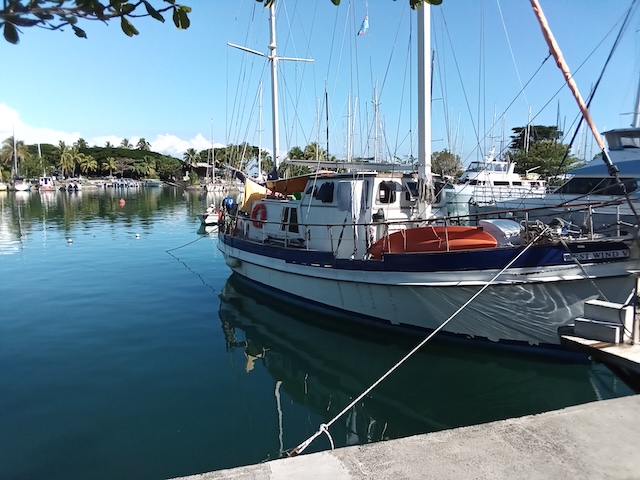
The customs officer was not quite hiding his smirk every time he produced a new form. I thought the whole process was amusing. After a large number of forms which I did not count and Phil changing to a dangerous shade of red, we were given our departure papers.
In the taxi back to Vuda, with Phil slowly regaining normal colour, I thought, ‘tomorrow we are off’. The high seas awaited. Tomorrow came and we departed Vuda at near low tide, bumping our keel on the bottom of the channel leaving the marina. I should have realised something was up when sails were not raised immediately after clearing the marina. We motored the ten miles or so to Musket Cove and tied up to a berth on the causeway.
The weather wasn’t right
The high seas had to wait. Phil said the weather wasn’t right. The reality in July is that the weather wouldn’t be right until October. No-one mentioned that.
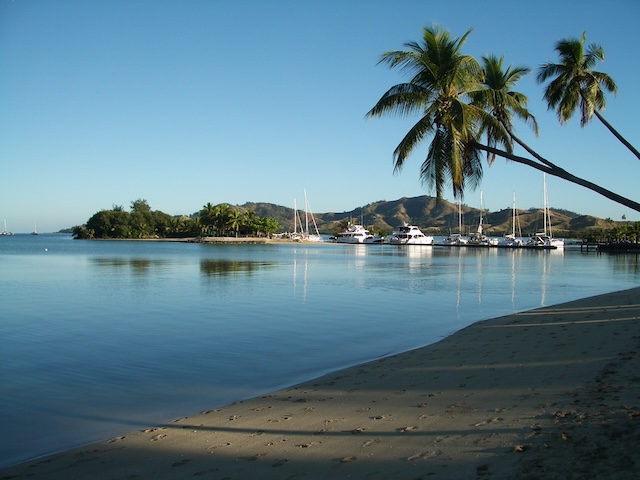
At Musket Cove it was hard to think about anywhere else. It looked like paradise. The weather said paradise. The island bar said paradise. The beach said paradise. I wasn’t ready for any of that. I had planned for an uncomfortable sailing passage. But I promised myself I would return with Ann, my wife.
After a week in paradise we left. Phil was right about the weather, it wasn’t right. We headed straight into a southerly. New Zealand is just about directly south of Fiji. But the wind meant our course was south east. More correctly east south east. Phil started talking about how easy it would be to get to Brisbane. A topic he didn’t drop until we got to Norfolk Island. When we had passed the longitude of New Caledonia, Alan and I turned the yacht, on our night watches and made for the south. Some of us had to get home.
A night to remember
Then we had a night to remember. The weather was not bad. Wind about 20 – 25 knots, seas between one and two meters. The spectacular part was that every time the yacht came down off a wave the water flashed a bright green light. I have sailed those waters another eight times since then and never seen anything like it. For the whole length of the yacht and about two meters each side the water was a bright green light. Bioluminescent algae. Dense algae without any unaffected water.
Boisterous weather
The weather was generally boisterous for the whole trip. We spent two days in south south east trade winds and two meter seas at the start. A day of flat calm with 40 knot squalls, hidden in cloud pillars. A gannet landed on the yacht that day. The four of us were sitting around the rail at the back of the cockpit. The gannet landed on the rail immediately behind my right shoulder. A day sailing amongst 10 meter high swells with only 10 knots of wind. Smooth water but massive swells 100 – 200 meters apart.
As we approached New Caledonia we had swell and waves from two directions. About 1.5 meters high. At first it was very uncomfortable, then Alan started turning the yacht and staying on the peaks of the crossing waves. It became a game. We all had a go at seeing who could stay on the tops longest. Alan won, going past 10 wave fronts before being dropped into a hole in the water. All under sail. That night with the yacht bouncing its way through the mixed swells we lost our spinnaker. Torn right through the middle after collapsing and then catching the wind again. The top section wrapped itself around the mast. We couldn’t get it down and couldn’t raise the main.
I was the lightest of the three males on board so got the job of going up the mast to free the sail. Fortunately it was only 20 minutes work. There was a moment when I thought I wouldn’t be able to do it. But just after that it came free. We dropped the remnant of sail into the water then hauled it on board.
Where are Hunter and Matthew Islands?
Half way through another night we were woken by Phil stamping on the cockpit deck. In the darkness he had seen something on the horizon. We were so far west by this time we had sailed off our paper charts. So the woman on board, who’s name I cannot remember, turned on the small GPS (with C-Map charts) and found we were somewhere near Matthew Island. We passed both Hunter and Matthew Islands¹. The first I knew of their existence.
Later that day the toilet failed. I was given the task of repairing the pump motor. After dismantling it and testing its circuits I pronounced nothing was wrong. I reassembled the pump and left Phil to fix the plumbing, where the problem was. Phil was a retired plumber.
Once we were further south the wind disappeared completely. My guess was that we were about 100 miles north of Norfolk Island by that time (Day 7). Approaching from the west side. Phil really had tried to get to Australia.
Getting off at Norfolk Island
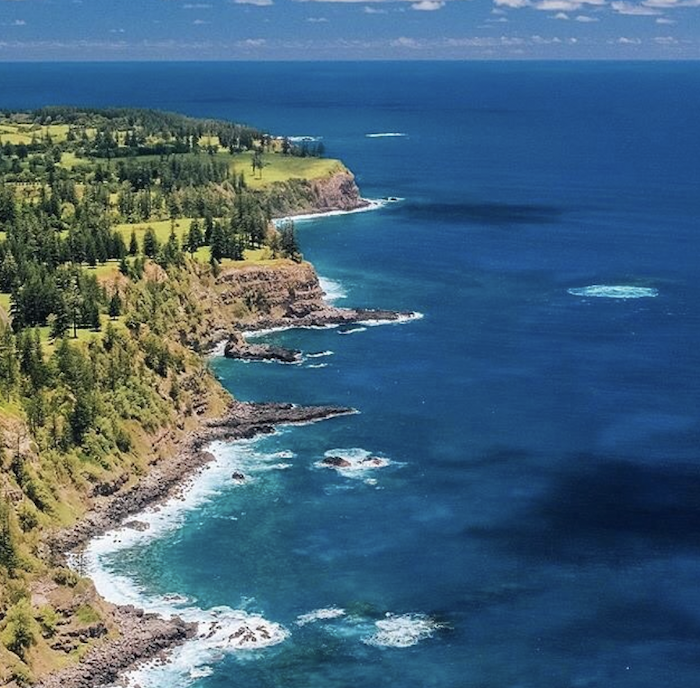
We made it to Norfolk, by late evening, motoring with no wind and no sails. A spur of the moment decision by Phil took us down the east coast of Norfolk. A lucky decision. We did not have a chart and there are reefs on the west side. We made our way past Cascade Bay, where we should have stopped, down to Kingston at the south end. The following morning we relocated to Cascade Bay.
When Phil was sailing around the Yasawa Islands he had “lost” the dinghy. Getting ashore was not going to be easy. Norfolk doesn’t have a harbour. Norfolk doesn’t have a wharf or jetty. We used the radio to arrange for more fuel and water and then got the boat which delivered those, to take us ashore. We were met by the customs officer who took us to his office, in the settlement of Burnt Pine. Guess how it got that name.
I made a tactical error at this point. I called home. More correctly I called work. Ann was running our business. Ann was looking after our three young children. Ann was organising the business being moved to a new building. I was supposed to have reached home about a week earlier. I had a significant business appointment booked, three days later. The message from home was concise, direct and definite. Even cold. Stop larking about. Stop sailing. Fly home.
I got back to the yacht and told my crewmates. Getting ashore again was the biggest obstacle, without a dinghy. The yacht anchored about 100m away came to my rescue. He dropped me at the causeway in Cascade Bay and I managed to get myself and my luggage ashore, only getting slightly wet.
A Nor-folk welcome and helping hand
Having been ashore earlier in the day I knew there was a phone on a pole at the end of the road. So as darkness fell I made my way to the phone, intending to call every hotel in the phone book until one agreed to come and get me from the dock in Cascade Bay. When I got to the phone I found it was too dark to read the phone book. But I also found a light switch for the street light on the pole.
Problem solved, so I thought. However no-one was answering phones at the hotels. It was 7:30 at night, they had all gone home. Then a vehicle drove down to the lamp post. Relief. I asked if I could get a lift into town. The driver said okay and told me he was surprised to find me. He had driven down to the lamp post to turn off the light. Despite that he offered to take me around all the hotels until I found one with a room. Fortunately for both of us the first hotel had a room.
The next day I booked a flight home but it was departing the following morning. There were only three flights each week. I had to go home via Sydney. So I had a quiet day in Burnt Pine and got to meet that extraordinary group, the Norfolk Islanders. Fiji is a very welcoming and friendly place where visitors are treated very well and people go out of their way to be helpful. Despite all that, they could take lessons on being welcoming from the Nor – folk.
That evening I decided to have a meal in a cafe, not at the hotel. I arrived at the cafe at about 6:30pm and ordered a simple meal of fish and vegetables. The cafe owner served the meal and then said he was planning to go home soon. I said I would hurry my meal. His response, “no please don’t hurry, I am going, but you stay and enjoy your meal, – and remember to lock the door when you leave.”
Ann and I went back to Norfolk Island two years later, to celebrate our 25th wedding anniversary. We got to Musket Cove in 2011.
Kahukura 11 took another seven days to reach Wellington, New Zealand. Alan told me that, as expected, the worst weather was the two and a half days on the west coast of New Zealand. Kahukura 11 now claims the NZ record for the slowest sailing trip from Fiji to NZ – 15 days.
John Manning
Kapiti, New Zealand
…………………………………
Footnote:
¹ Matthew and Hunter Islands are two small, uninhabited volcanic islands in the South Pacific Ocean located about 300 kilometers east of New Caledonia and southeast of Vanuatu. The islands are currently in a sovereignty dispute as France claims the islands as part of New Caledonia, exercising administrative control, while Vanuatu claims the islands as the successor state to the New Hebrides condominium, viewing French control as a remnant of colonialism. Bilateral negotiations between the two countries broke down in mid-2026 after failing to reach a consensus. Source: ABC News
…………………………………
About the Author
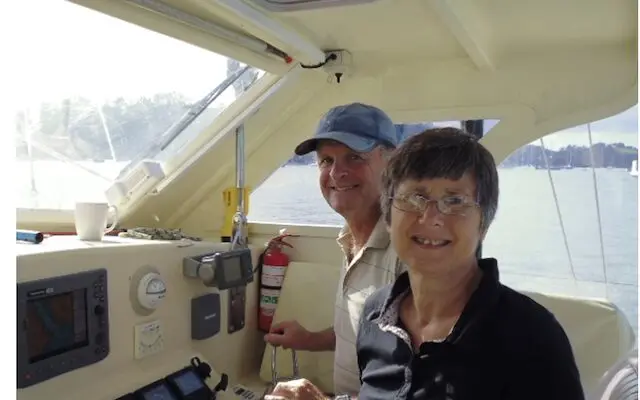
Retired New Zealand sailor John Manning and his wife Anne live just north of New Zealand’s capital city of Wellington, on the Kapiti Coast. He has sailed the New Zealand to Fiji passage five times. He is planning a short trip to Sydney this year crewing on a German yacht and has just replaced the engine in his yacht West Wind V which he keeps at Mana Marina in Paraparaumu.
…………………………………
Read John’s other reports for Noonsite:
- Australia, The Whitsundays: No Better Place to Be
- After the Sails are Furled: Part 1 – Last Offshore Passage
- After the Sails are Furled: Part 2 – Looking Back on 25 Years of Cruising
- After the Sails are Furled: Part 3 – That Was Then This is Now
………………………………
© 2026 Noonsite. This content was edited by Noonsite. Do not reproduce without permission. All rights reserved.
The opinions expressed in this article are the author’s own and do not reflect the view of Noonsite.com or World Cruising Club.
If you have found this information useful, become a paid member to enjoy unlimited use of Noonsite plus many other perks. Your membership fees really help our small, dedicated team keep country information up-to-date in support of cruisers worldwide. Find out more about Noonsite Membership levels and benefits here.
Subscribe to our FREE monthly newsletter: https://www.noonsite.com/newsletter/
Leave a comment
You must Login or Register to submit comments.