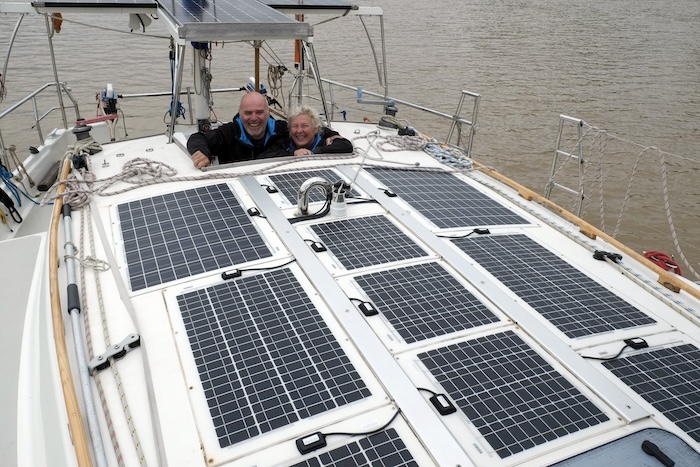
Names of Owners (and crew): Peter Hoefnagels (owner) and Inge van Berkel (partner and most regular crew-member).
Other crew: Peter, Bert, Hans, Theo, Anna, Caroline, Sue, Maurizio, Pierrot, Brent, Maurits.
Nationality: Peter and Inge: Dutch
Boat Name: Ya
Boat Type/Model and Size: Koopmans, 10 x 4 m
Your Home Port: Rotterdam/Burdaard
Website: www.fossilfreearoundtheworld.org
Describe what sort of cruiser you are:
2016-2018: Peter made his first circumnavigation with guests.
2020-present: Peter’s second circumnavigation with Inge joining for longer periods. Peter also made several passages with crew.
What type of cruising are you doing currently: A Refit in Whangarei, New Zealand.
What were the key reasons you selected your current boat? Independency, off grid, sustainability. Still has the feeling of an open boat. Great comfort inside (beam, windows). Own design of the rig, so has many things that are easier for cruising – like an open deck, without ‘toe breakers’.
What other boats have you owned?
A Flying Junior, a 5.5 meter kimkeeler yacht, a ‘Grundel’ (Dutch flat bottom yacht with leeboards), and a Dufour T7 – where Peter put in the panorama windows.
What changes have you made to your current boat? A new battery bank.
Most useful equipment fitted and reasons for this choice: The centre board, so we get everywhere. The mizzen, so we can also sail in very light weather. The long 4 meter spinnaker pole, made of carbon of only 3.5 kilos, so even Inge can handle it.
Equipment regrets, or things you would do differently: The anchor winch without a redundant manual option (only the electrical option). The hatch in the saloon deck is one we never use and it lets the sunshine in – which is not nice in the tropics. We don’t need this hatch for the light, because there is plenty from the windows in the side boards.
List the countries you have cruised:
Netherlands, England, Scillies, Belgium, France, Spain, Portugal, Porto Santo, Madeira, Canary Isles, Gambia, Cabo Verde, French Guyana, Suriname, Barbados, Grenadines (several islands), Martinique, Columbia, Dominican Republic, Bonaire, San Blas, Panama, Marquesas, Isles Gambier, Tuamotus, Raiatea, Samoa, Tonga, Fiji, New Zealand, Australia, Indonesia, Mauritius, South Africa, St. Helena, Azores.
Future cruising plans: Indonesia. All other plans are written in the sand at low water.
List the oceans/seas you have crossed: North Sea, North and South Atlantic Ocean, Caribbean Sea, Pacific Ocean, Indian Ocean.
Approximate sea miles: 50,000 NM
Scariest day on the water:
Inge’s scariest day: When there was hardly any wind and 2 orcas started following Ya on our way from Madeira to the Canary Islands. We had just heard the stories about Orcas attacking yachts in Spain and Portugal. It turned out they were just curious and they followed us for a while. Magnificent creatures!
Peter’s scariest day(s): Being aware that you are so vulnerable as a traveler, especially as a yacht owner, the scariest hours are often during the bureaucracy. The darkest hours were during clearance in Curacao, Colombia, New Zealand. The fear of the Ecuadorian authorities was so big, that we decided not to go. Although we had everything lined up for a great ‘Sail a Future’ Project in Manta.
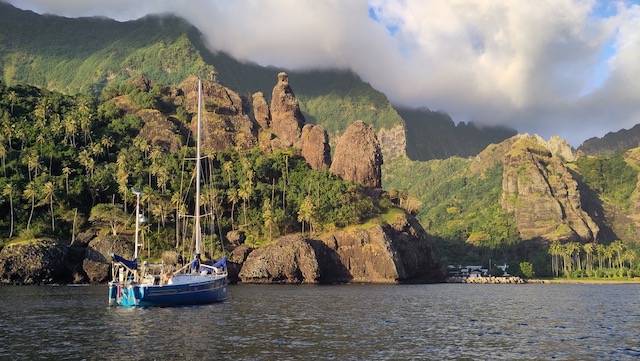
Best cruising moment: There are many, but Inge’s best moment is the classical one – entering the Maronie river (French Guyana) after her first ocean crossing. Sharing moments with fellow cruisers, such as watching the sunset with Stig and Anna on a deserted island in the Gambier archipelago.
Peter’s best cruising moment is having an extensive Sunday morning breakfast on an exceptionally flat Atlantic Ocean while sailing in very light winds with the Parasailor up.
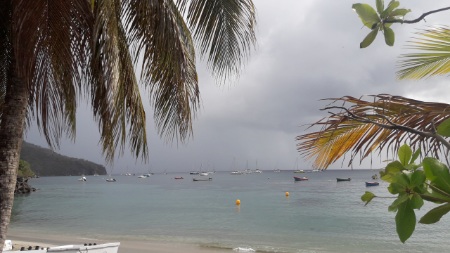
Favourite cruising area and why: Large estuaries with sand banks. Example is the Waddenzee (Northern of Holland-Germany-Denmark) because we can dry out in nature and experience the forces of nature. The Ria de Aveiro, Portugal, is another example – because we can dry out in nature. It’s smaller, but there is different nature, like flamingos next to your boat, no huge dykes and only small scale fishing (no industry) and a pleasant climate.
Favourite anchorage: Manihi (French Polynesia), Ria de Aveiro (Portugal), Paessens Rede (Waddenzee)
Favourite cruising apps: Depending on the area we are cruising, so currently noforeignland.
Favourite cruising websites: Noonsite, Soggy Paws.
Favourite cruising books:
- Inge’s: Clive Cussler’s books
- Peter’s: Joshua Slocum
What advice or message would you want to pass on to anyone new to cruising or thinking about casting off the dock lines? Get confident in your sailing and in your boat on smaller trips, and build up gradually before starting to cruise the world.
Why cruise? In a few sentences, what is it that inspires you to keep cruising? Nature is the key word to cruise. The local culture is the second. Sailing is by far the best way to experience it, and a joy to do, especially because Peter learned how to sail.
Any other comments about the cruising life? Cruising the way we like it, costs a lot of time, because you want to stay longer. Let’s put a critical note here. The current cruising world is busy, with a lot of boats. Even in the Pacific it tends to become a complete industry. It is easy to stay in the ‘cruisers bubble’. It is even getting difficult to get really remote and enjoy nature and the culture of the local people.
Peter Hoefnagels and Inge Van Berkel
SY YA
……………………………………
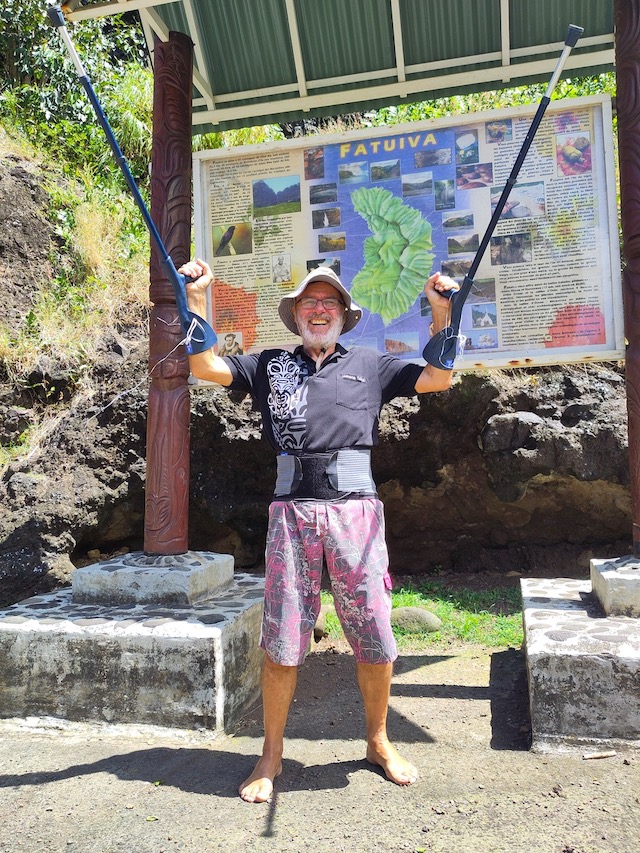
Peter Hoefnagels is president of the Clean Wave Foundation, skipper of the Ya and the initiator of the fossilfreearoundtheworld campaign.
Together with his partner Inge van Berke, they are sailing around the world without using fossil fuels on board their boat Ya. No diesel, no gas, no petrol. On-board life is energy neutral and very comfortable. Says Inge: “Sustainable cruising means sailing globally, living locally. We buy, eat, live and act where we anchor. With the locals we exchange information and methods about sustainability and living self supporting. Whatever we learn from them, we share with you on our blog. In exchange, we deliver a clean wave in all corners of the globe.”
- See their website: FossilFreeAroundtheWorld for articles on generation and the crucial Energy Balance in set a yacht to be fossil fuel free.
- About their fossil free circumnavigation, see the history section on the website. (If you understand Dutch, then go to www.duurzaamjacht.nl and read all about it)
- Contact SY Ya: info@fossilfreearoundtheworld.org
……………………………………
Other Reports from SY Ya
- South Pacific, French Polynesia: Coping with Murphy’s Law and a Medical Emergency
- Colombia, Cartagena: Noisy and Busy but Charming and Friendly (December 2022)
- Dominican Republic: Coping with the Officialdom of Cruising (November 2022)
- The Gambia: A Great Place for Sailors (January 2022)
- Ya: The Yacht That Sailed the World Fossil Fuel Free
…………………………………
© 2026 Noonsite. This content was edited by Noonsite. Do not reproduce without permission. All rights reserved.
The opinions expressed in this article are the author’s own and do not reflect the view of Noonsite.com or World Cruising Club.
If you have found this information useful, become a paid member to enjoy unlimited use of Noonsite plus many other perks. Your membership fees really help our small, dedicated team keep country information up-to-date in support of cruisers worldwide. Find out more about Noonsite Membership levels and benefits here.
Subscribe to our FREE monthly newsletter.
Leave a comment
You must Login or Register to submit comments.