
A Country of Keen Sailors
New Zealand has a lot of keen sailors, so getting crew for a yacht is not difficult. Usually there will be more volunteers that crew positions. I was asked to do this job because the delivery skipper knew me and needed crew at short notice.
In the end I sailed only half the delivery of a trip aboard a small yacht called the SV Maud, from Auckland to Wellington. I did the leg from Napier to Wellington. When David called me he was already in Napier and was waiting to leave the following evening. Wellington is normally 32 – 36 hours sailing from Napier, so if you leave in the evening from Napier you arrive in Wellington in the early morning of day two. On short notice, I made arrangements to get to Napier. The best option was a bus which would get me there about 3 hours before the planned departure.
It was early spring, September. Weather likely to be variable despite the short distance of 200 miles. The coastline between Napier and Wellington is renowned as being one of the worst in New Zealand. Weather changes rapidly, squalls and whirlwinds come out of the valleys whenever there is a northerly or northwest wind and there are no harbours or shelter of any sort. Toward the south there is nothing but sea, until you reach Antarctica.
Small but Magnificent!
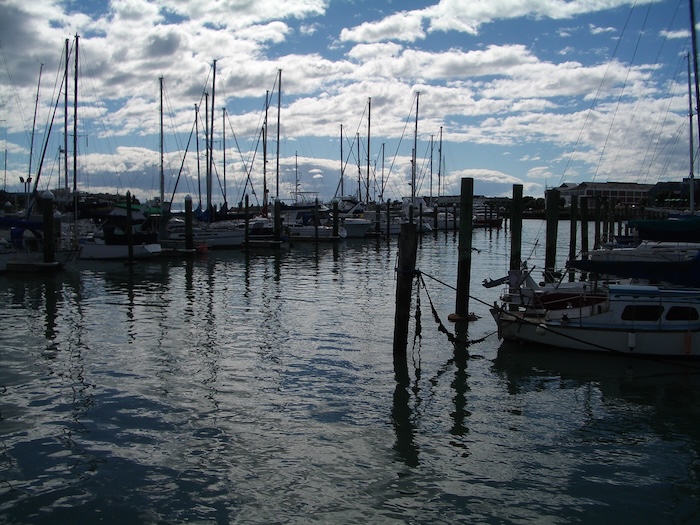
When I got to Napier I walked the short distance from the bus stop to the marina and found the little yacht Maud, tied up at the yacht club pier. My first impression was “small yacht”. After I got on board my second impression was
“magnificent yacht”. Small yes, but to the eyes of someone who spent half his working life on ships and yachts, this was a masterpiece. It was a Danish built yacht that an English couple had sailed from Europe to New Zealand. The build quality was undeniable to anyone who understood boat building. And because of its recent past it was fully equipped for ocean travel.
Sad Story
The story of its former owners was a sad one. The English couple had started a circumnavigation when the husband had been diagnosed with a terminal illness. They had left England about 18 months earlier and sailed across the Atlantic and Pacific pursuing a dream the man had for much of his life. On reaching New Zealand health matters took over. The man died, his wife sold the yacht to return home. Everywhere you looked on this yacht you could see remnants of their voyage. I wished I could have been part of that.
We departed a bit late, after dark, at 8:30pm. Leaving Napier harbour requires making a cut inside a reef or else going wide outside the reef. At night and not knowing the area well, we took the longer path outside the reef, because there was a navigation beacon on that route. We then turned east toward Cape Kidnappers and I went to bed. My watch was 4am to 8am. There were three of us on board.
My first night watch was all plain sailing. I got myself used to the idiosyncracies of the self steering gear, set it up for my course then wiled away the time until morning. At the end of the watch we were on the east coast sailing south in pleasant weather, moderate northerlies and calm sea, keeping close into the coast because the waves were noticeably larger about two to three miles further east. The day was spent in these same conditions, all of us knowing that we were going to face harder weather once we turned west at Cape Palliser.
Troublesome Patch of Water
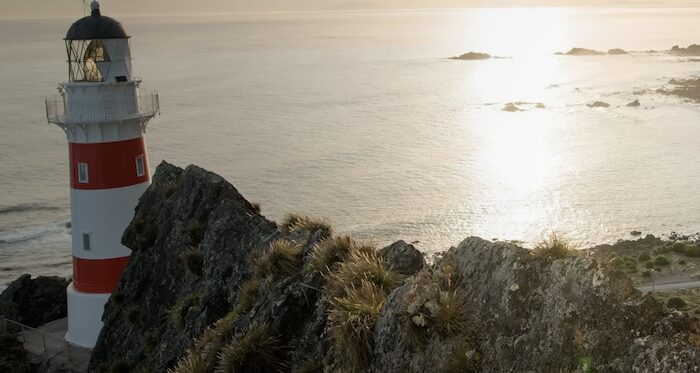
The passage from Cape Palliser to Wellington Harbour is well known for being a troublesome patch of water. The winds in that area are normally northwesterly between 15 and 30 knots. That’s the good weather. Palliser Bay is a deep bay about 10 miles wide which gives the sea a lot of fetch. So as you sail between Cape Palliser and Baring Head (just outside Wellington Harbour) for most of the time you are about 15 miles from shore and 15 knots of wind is enough to create 1.5 meter waves. And they are waves. White caps, curled at the tops. They hit hulls hard and leave you pitching fore and aft, which always slows a yacht and makes the passage last twice as long as it should. We all knew it was coming. We were all Wellington yachties.
But that was tomorrow. We were enjoying sailing a beautifully built yacht that moved well and kept its course. However at only 32ft waterline it was slow. We were moving at about 5.0 knots. My next night watch began at 4:00am the following morning and I noted from the lighthouses visible that we were considerably behind schedule – about eight hours late. I blamed it on the crew, a yacht this beautiful could never be at fault.
At the end of that watch we were rounding Cape Palliser when we should have been entering Wellington Harbour. The weather became its normal boisterous self. A northwester of about 20 knots picked up and the sea state with it. The yacht was superb. For such a short hull it hardly pitched at all. Any amount of sail could arrest the roll and it could hold much more sail than I had imagined, without heeling much at all. So to get to Wellington we headed slightly south of our course and kept sail up. We were directly abeam the small settlement of Nawi on the south Wairarapa Coast. The wind had picked up to 30 knots, seas were about two meters and we were sailing hard. It was 8am.
At midday Tony decided we should change the foresail to something smaller and point the yacht more directly at Baring Head. So we did that. We were still sailing as hard as the yacht could go. It was 12:00 midday we were directly abeam the small settlement of Nawi on the south Wairarapa Coast. At 4:00pm David suggested starting the engine. We were sailing as hard as the yacht could go. We were still directly abeam the small settlement of Nawi on the south Wairarapa Coast.
Eight Hours and 400 Metres
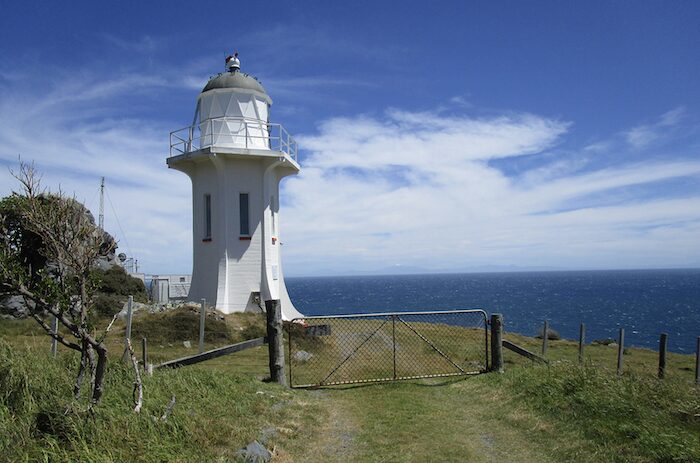
That was probably equal to the hardest eight hours of sailing I have ever done. The yacht stood up well and I was amazed by the stability, of such a small hull. But we would not have gone forward by more than 400 metre.
Dropping the sail and motoring to Baring Head was the solution. And we would have done that if the engine had worked. Every time we started the engine it stopped 10 minutes later. David put me to work checking the engine and the fuel system. I had no manuals and no idea of the control systems. I checked what I could and found nothing to fix. So we sailed on.
The weather got steadily worse and we were being pushed further south. At 10 pm I thought to myself, I have been awake for 18 hours. I wondered how long this could go on. We were still another day’s sailing from our destination marina. We were supposed to have been home about eight hours earlier. Because of the deteriorating weather, I suggested we should call Wellington for a tow into the harbour. That wasn’t something that was going to go down well amongst this group of old sailors. But I knew, because I was the youngster, I was going to be doing any hard work, and I had already been up for 18 hours.
“Hang in There”
In the end David called the Wellington Police (the only rescue service with a boat that could tow) to see if they could help. He explained our situation with a failed engine and not being able to progress under sail. Now here is a characteristic of Wellington. In the harbour it can be completely still and six or seven miles south of the harbour entrance there can be winds of 35 knots and seas of 3 meters. The Police, in Wellington Harbour, told David to hang in there they did not see any reason to tow us.
About half an hour later the Police radioed back and asked for some details. One of the things they wanted to know was who was crew. I took the call because I was on watch early. I told them the crew was David White, 68, Tony Nesbit, 73, and me, 54. I was the youngster on board. They then repeated their earlier message, ‘just hang in there’ and added ‘we think the wind is dropping’.
So we carried on sailing. By this time we had managed to move the yacht a few miles. We were now south of Baring Head in 35 knots and 2 – 3 metre, rough seas. This tiny yacht still a stable and even comfortable place to be. But we had been blown to the south and we were about 10 miles from the coast. I was doing everything I could to sail upwind, back toward the harbour, without much success.
“Turn On Your Lights”
An hour later the Police called again. This time it was the Police launch calling, they said turn on all your lights, “we are somewhere nearby but cannot find you”. Everyone of us was awake and all lights went on. Then we saw her, Lady Elizabeth 111. Coming out of the blackness of an overcast night, appearing and disappearing behind waves. In a few moments she was only 20 metres of so from us, but on that night it looked much further. They were now shouting instructions. We had to catch and secure a tow rope. There would be one chance only.
I remember seeing a large Policeman hurl a coil of rope in our direction, while I was thinking no-one is strong enough to get that much rope that far, the rope hit our deck next to the mast. They were shouting, we were rushing, we got to the rope before it disappeared into the water and we got it around a cleat. We then moved the rope to the forward cleat for towing. I tied it, Tony checked it.
Under Tow
It was then that the first wave hit me. I was crouching by the cleat at the front of Maud. The rope tightened, we rolled over a wave, into a trough and through the next wave. The top of the next wave being above my head, I was submerged for one or two seconds. I had good quality wet weather gear. We had been in rain and wind for several hours by then and I was still dry. But wet weather gear doesn’t work under water. Soaked to the skin, I made my way back to the cockpit and curled into a corner to stop myself freezing up. We were being towed, I would be home soon.
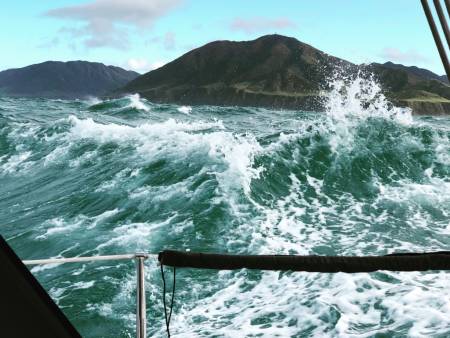
Lady Elizabeth tried towing us at 5 knots. Three and half hours to home. We were being dragged through the waves, the bow being pulled under. They slowed and tried 3 knots. Five and half hours to home. No change. They slowed to 2.5 knots. Seven hours to home. All good on the tow. Except every hour they insisted we check the tow line. Every hour I went forward to check. Every hour another wave submerged me on the foredeck. Every hour I got that bit colder. It was well after midnight. We arrived at Seaview Marina in the northeast corner of Wellington Harbour, sometime after 8am. It was low tide so the Police launch couldn’t get us into the marina. We had to use our “10 minutes at a time” engine, to get into the marina and into a berth.
David took Maud to the east side of the marina, to a pre-arranged berth, which was two along from my yacht ‘Ocean Breezes’. Arrival 24 hours late. By this time I was shivering uncontrollably. David sent me home to get warm and said he and Tony would tidy up. I thought of stopping at my yacht to dry off, but went directly home so I could tell Ann I was okay.
Late that afternoon Ann and I went back to the marina to see how David and Tony were getting on. They were cleaning up after the soaking the yacht received at the entrance to Cook Strait. Everything looked okay and the new owner had come to see his yacht.
About the SV Maud
With a length 10 meters, Maud was built by Nordship in Denmark (so I was told) – design unknown, canoe stern, deep keel (for its length) at approx 2.0 meters and fibreglass construction.
I was told a week later the engine fault was just a loose wire. The yacht engine had safety systems and an electronic controller. The loose wire was read by the controller as low oil.
The new owner renamed the yacht, Wiropet. It stayed in Wellington for about one year before being moved to Nelson. I last saw this yacht in 2024 on a mooring at Pilot Bay, Tauranga Harbour. I have a list of yachts, in my head, that I would like to own. Maud is next on that list.
John Manning
Kapiti
New Zealand
…………………………………
Other Articles by John for Noonsite:
- After the Sails are Furled: Part 1 – Last Offshore Passage
- After the Sails are Fuled: Part 2 – Looking Back on 25 Years of Cruising
- After the Sails are Furled: Part 3 – That Was Then and This is Now
…………………………………
© 2026 Noonsite. This content was edited by Noonsite. Do not reproduce without permission. All rights reserved.
The opinions expressed in this article are the author’s own and do not reflect the view of Noonsite.com or World Cruising Club.
If you have found this information useful, become a paid member to enjoy unlimited use of Noonsite plus many other perks. Your membership fees really help our small, dedicated team keep country information up-to-date in support of cruisers worldwide. Find out more about Noonsite Membership levels and benefits here.
Subscribe to our FREE monthly newsletter: https://www.noonsite.com/newsletter/
Leave a comment
You must Login or Register to submit comments.