
Clearing into Thailand proved more complicated than expected for this cruising family. Despite following guidance from yacht clearance officials when submitting their arrival paperwork, a misunderstanding led to a chain of issues that continued all the way to their next destination, the Maldives. Their experience highlights how complex clearance procedures can be, and why it’s worth double-checking requirements through resources like Noonsite or considering the support of a reputable agent. Here, skipper Brad shares their story.
Arrival in Thailand
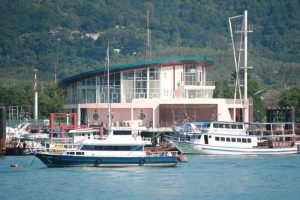
We arrived at Chalong Bay, Phuket, on 9 March after a passage from Langkawi, Malaysia, with six onboard: our family of five, along with Grandma, who was booked to depart Thailand by air from Bangkok the following day.
As with any international arrival, our first stop was with the authorities in Chalong Bay, specifically the yacht registration office. We explained our situation and sought guidance on the correct procedure for removing Grandma from the crew list. The advice was straightforward: list everyone on board as crew, then clarify the details with the Harbour Master.
We followed those instructions. At the Harbour Master’s office, he processed our papers, produced the documents in triplicate, and advised us to refer to the Immigration officer regarding Grandma.
All Normal Until It Was Not!
All was proceeding as normal, so you can imagine our surprise when it started to unravel.
The Immigration officer was abrupt, perhaps a little condescending, when he said that Grandma was stuck (she could not leave the vessel) – thumbing towards the sign on the wall behind him. The issue, as it was presented, stemmed from her being listed as “crew” rather than as a “passenger” We explained that we had followed the directions given by the yacht registration office and asked for permission to return and amend the crew list accordingly, to restart the process correctly.
That request was denied.
Instead, his demeanour changed somewhat, and he said that he could fix it; the matter could be “resolved” with a payment of 2,000 Thai baht…in cash, and he made it very clear that no receipt would be issued.
With three kids and the mother-in-law in tow, plus never wanting to upset government officials, I figured, hey, at least it’ll be sorted, so I agreed.
Shortly thereafter, the officer stamped Grandma’s passport, but for the remaining five passports, he attached a TM1 form to each. When we asked for clarification, he explained that this document acted as a “bond” for crew members and was common practice for skipper and crew. He said that upon departure, the forms would be removed, passports stamped, and all would be good. While unconventional from our past experiences, we accepted this at face value as the prescribed process. I figured if it is standard for the Skipper, then it really makes no difference whether it is one or all of us.
Grandma flew home and we enjoyed a few days finalising boat projects and provisioning before returning to check out.
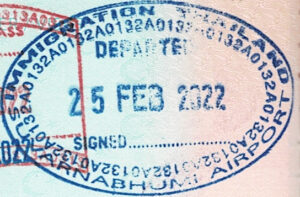
This time, a different Immigration officer was on duty. He reviewed our documents but declined to issue exit stamps directly into our passports, stating that the stamped TM1 paperwork already in our passports was sufficient for our next port of entry. This directly contradicted what we had been told previously. We asked again—three times, in fact—for our passports to be formally stamped out of Thailand.
Each request was flatly refused.
Passage to the Maldives
Our next destination was the Maldives, and we had already made contact with our agent, Hussain, so we reached out for his advice. He assured us it would be fine, so we made final preparations and set sail on the 1,600-mile passage to Uligan in the northern Maldives.
Calm was restored onboard, and we were finally pointing west. It was good to be back on a long-distance passage.
Then, 500 miles west of Phuket—some 250 miles west of the Nicobar Islands—we heard news of a boat being refused entry to the Maldives on account of having this TM1 form in their passports.
We reached out to Hussain again, who once more said it would be OK, so we allayed our fears with the belief that there must have been other mitigating circumstances for the other boat, that we had little option but to continue, and that our agent said it would be OK.
Arrival Shock
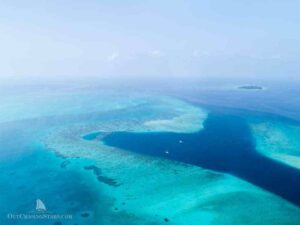
So imagine the shock when on arrival, the Immigration agent—having called his superiors twice—had to inform us that he was not able to stamp us into the Maldives. We informed them that this was likely to happen again unless the two countries’ immigration offices resolved a difference in expectations. That we had no options: our port clearance (zarpe) noted Uligan as our next port, and the cascade effect meant not seeing the Maldives, not going to the Chagos Islands, and not least the implications for our arrival into the Seychelles, having been “rejected” by the Maldives.
The Immigration officer was sympathetic, but his hands were tied.
Our agent, Hussain, sprang into immediate action, making contact with the Maldivian Foreign Ministry, the Thai Embassy, and setting the wheels in motion for the two countries to reconcile the situation.
We provided a formal “Master’s Statement” outlining the facts that led us to this point, complete with thumbprint! Then it was just a matter of wait and see.
Thankfully, sleep was forthcoming considering the past 11 days at sea, but we both woke with the same determination: we can’t leave here; it must be resolved—and we’ll refuse to leave until it is.
As it was, none of this was necessary. When Starlink turned on in the morning, there were WhatsApp messages from Hussain late into the evening, and one from the Immigration officer confirming that a resolution had been achieved near midnight. We would be granted access, and the Thai government would investigate this unusual behaviour of the Immigration officer in Chalong—not least the corruption.
The Benefit of Hindsight
Hindsight is a wonderful thing, but with its benefit, we rationalised that he likely wanted to make it look like he was doing something special for Grandma—and justify his 2,000 baht (with no receipt)—so he inserted the TM1 forms, a process we believe is normally reserved for commercial shipping.
Had he been on duty the day we checked out, I’m sure he would have removed them, stamped the passports, and we’d have been none the wiser. But alas, he had a day off.
Lessons learned: even having checked in and out of over 40 countries, a dodgy government official can still ruin your day. We have had some difficult experiences with officials from time to time, but never such overt corruption—except perhaps in Belize.
Never rely on opinion, and never leave a country without a stamp in your passport. We should have stood our ground, made a fuss, and requested to speak to a supervisor at check-out. While the officer on duty that day was likely correct not to remove the form, it would have brought the issue to a head in that office, in that country and hopefully been resolved then and there. The alternative—dealing with it on arrival—could have gone much worse.
Clearly, we owe a big thank you to our agent, Hussain, who we feel played an instrumental role in resolving the matter.
Updated facts: Costs for checking in and out of Thailand as of March 2026:
- Harbour Master: 500 baht to check in, 500 to check out = 1,000 THB
- Immigration: 30 days, 200 THB (with a receipt)
- Customs: check-in, weekdays free; weekends/holidays 800 THB. Check-out, weekdays 200 THB; weekends/holidays 1,000 THB
And yes, all of the above costs came with receipts!
Post script
Thankfully the Maldivian foreign ministry reached out to the Thai immigration authorities and they have reconciled. The Thai immigration office will now apparently conduct an internal review of what happened. And the Maldivian authorities are also following up with Thailand to say they will reject future boats arriving with TM1 forms; they have taken photocopies of the TM1 forms to follow up with Thailand.
But the best news was we were approved to enter the Maldives!
Bottom line is:
The Maldives have only seen this twice, SY Yamay, (who arrived two weeks before us) and ourselves. I don’t think Manu on Yamay was planning on spending much time in the Maldives, so he didn’t really fight that hard. They helped him with fuel and he carried on. They asked us to spread the message far and wide, as we already have – especially through Noonsite.
My suspicion is that the chap who extorted us at check-in put the TM1 forms in our passports to make it look like he was doing us a huge favour by stamping my mother-in-law’s passport so she could fly out of Thailand. The TM1 form, I believe, is for commercial vessels to bond crew to the vessel.
The officer at check-out was possibly justified in not removing the TM1 form and stamping our passports, as was promised at check-in.
So, I think it all comes down to a corrupt official, but at least it is now resolved.
Brad
SY Spirit
………………………………
The opinions expressed in this article are the author’s own and do not reflect the view of Noonsite.com or World Cruising Club.
…………………………………
Find out all news, reports, links and comments posted on Noonsite, plus cruising information from around the world, by subscribing to our FREE monthly newsletter.
If you have found this information useful, become a paid member to enjoy unlimited use of Noonsite plus many other perks. Your membership fees really help our small, dedicated team keep country information up-to-date in support of cruisers worldwide. Find out more about Noonsite Membership levels and benefits.
Leave a comment
You must Login or Register to submit comments.