

Dyneema for Cruising
The word Dyneema is apt to conjure up images of high-performance, highly tuned racing boats hurtling round the cans with uniformed crew working furiously at the winches.
It’s not just in the racing world that Dyneema has its place, however. It can be an enormously useful material on cruising boats as well.
While plenty of liveaboard sailors will have running rigging made entirely from polyester, and will never have felt they needed to change that, modern cruising Dyneema running rigging offers three clear advantages: reduced stretch, more consistent sail handling and longer service life under continuous load.
These benefits are not about performance sailing but reliability at sea: halyards that hold their tension, reefing lines that stay where they are set and control lines that need less constant adjustment all contribute to safer, more predictable sail handling on long passages. For this reason, cruising Dyneema has become an increasingly common upgrade for yachts preparing for extended or remote cruising.
What is Dyneema?
Dyneema is a trade name encompassing various grades of ultra-high-molecular-weight polyethylene (UHMWPE). It is denoted and rated by an SK number, from SK75 to SK99. The higher the number, the higher the specification (and the cost). Dyneema’s initial strength-to-weight ratio is second to none among fibres used for yachting, but it has several more X factors too: very low stretch (unlike nylon, polypropylene and spun polyester, which are naturally stretchy) and excellent wear-and-tear endurance.
What is cruising Dyneema?
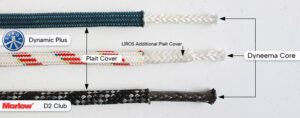
Some ropes, typically developed for high‑performance racing, use a core made entirely from Dyneema and are priced accordingly. Most cruising Dyneema lines, however, take a more balanced approach, including Dyneema sparingly within the core while retaining a durable polyester cover. This keeps costs under control while improving strength and reducing stretch compared with standard double-braid polyester. The Dyneema content is introduced in two main ways: either as a separate inner core with a supporting layer between core and cover, or as a blended core combining Dyneema with another fibre. The Dyneema itself is usually SK75 or SK78. In use, these lines handle much like traditional polyester, running smoothly through winches and clutches with familiar grip and feel. The polyester cover also provides excellent abrasion resistance, allowing repeated hoisting and reefing over long periods without accelerated wear. This blending of materials makes cruising Dyneema an effective and economical upgrade.
The limits of polyester offshore
Polyester has long been the default choice for cruising yachts. It is widely available, easy to handle and familiar to most sailors. For coastal sailing and seasonal use, it remains a sensible material. Offshore, its limitations become more noticeable.
Under sustained load over a long period, polyester creeps progressively. While this is rarely dramatic, it accumulates. Halyards lose tension over time, sail shape degrades and reefing points no longer align as cleanly as intended. During long passages this leads to the need for repeated re-tensioning, particularly as wind strength and angle change.
Why low stretch matters at sea
A lower-stretch, Dyneema-cored line means a halyard that holds its length, which in turn maintains sail shape more consistently. Luff tension remains stable, reefing points line up as expected and sails set more predictably, reducing the need for constant adjustment. Once a sail is hoisted or reefed, it tends to stay where it is set.
Reduced stretch also limits shock loading. When a rope does not elongate excessively under load, energy is not continually absorbed and released through the system. More of the energy therefore goes into moving the boat through the water. Over time, this can reduce wear on sails, fittings and deck hardware, lengthening service life.
Cruising Dyneema lines stretch less partly because of the specific properties of the Dyneema, and partly simply because the lines are stronger – the load placed on the rope is a lower proportion of its maximum break load compared to a polyester line.
Where upgrades make the most sense
Cruising Dyneema does not need to replace every line on board. Typical candidates include:
- Main and headsail halyards
- Reefing pennants
- Staysail or heavy weather sail halyards
- Vang and other highload control lines
- Backstay cascade systems
It is best to focus on lines that see sustained load or require consistent tension.
Splicing and long-term reliability
Dyneema cores are well suited to spliced terminations. A properly executed splice creates a strong, compact termination, with a much lower reduction in overall strength at the splice point compared to polyester lines.
They are also easier to inspect, as any movement or damage is visible rather than hidden within a knot.
However it is terminated, cruising Dyneema has the potential to sharpen up your running rigging, creating a much tighter set-up for long passages under sail.
………………………………….

Cruising Dyneemas available from Jimmy Green Marine
LIROS Dynamic Plus Dyneema
Cover: Close Weave 32plait 100% Polyester (8mm 24plait) stabilised structure
Core: Plaited Dyneema® SK78 with additional inner plait construction with enhanced LIROS-Heat-Stretch-System
Stretch: approximately 2%
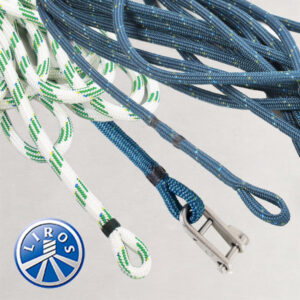
LIROS Dynamic Plus has a slightly thinner Dyneema core than LIROS Racer Dyneema with an extra inner cover plait to compensate.
The result is a solid round construction with excellent firm shape retention under load e.g. around sheaves and winches.
Diameters and Colours:
8mm, 10mm, 12mm – white with colour coding in Blue, Green, Red and Yellow plus full colour Red, Plain White (with LIROS marker yarn) and Steel Blue
14mm – white with colour coding in Blue, Red and Yellow plus full colour Steel Blue
Marlow D2 Club
Cover: 16 plait Polyester
Core: Coated 12 strand Dyneema SK75 blended with lightweight braided polypropylene fibre
Stretch: approximately 2.5-3%
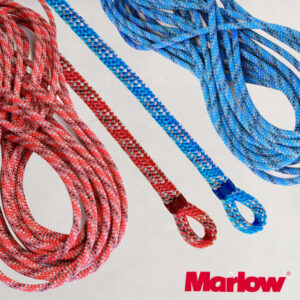
Marlow D2 Club is designed as an affordable upgrade to Performance Cruising Sheets, Halyards and Control Lines, making it possible to replace 100% existing polyester lines without going to the expense of Dyneema SK78 in the core. Dyneema SK75 is lighter and has far less stretch than polyester but does not quite match the enhanced performance of Dyneema SK78 or SK99. Armourcoating protects the core and makes it easier to splice.
Diameters and Colours:
8mm, 10mm, 12mm, 14mm – white, blue, red, black and green. Colours coming soon: blue fleck and red fleck in 8mm, 10mm, 12mm
Jimmy Green Marine can ship spliced, whipped and ready-to-deploy Dyneema lines, or just simple cut lengths if preferred, to all corners of the world.
Visit JimmyGreen.com to learn more about their products and services.
……………………………..
Related Links:
………………………………
© 2026 Noonsite. This content was edited by Noonsite. Do not reproduce without permission. All rights reserved.
The opinions expressed in this article are the author’s own and do not reflect the view of Noonsite.com or World Cruising Club.
Find out all news, reports, links and comments posted on Noonsite, plus cruising information from around the world, by subscribing to our FREE monthly newsletter. Go to https://www.noonsite.com/newsletter/.
Leave a comment
You must Login or Register to submit comments.
This article has some useful information. I have replaced my 1×19 SS wire standing rigging with dyneema. I do take issue with the paragraph on shock loading. The errors in this paragraph are somewhat mitigated by the final recommendation to use dyneema mainly on halyard and not sheets and guys, but the info on shock loading is not correct.