
Beginning the Adventure at Belém
Our true Amazon adventure begins in Belém. Ahead of us lie 300 nautical miles around Marajó Island to the mouth of the vast river delta. A distance that initially appears manageable on the nautical chart, but in reality is a completely unique way of traveling.
Anyone picturing pristine rainforest, utter solitude, anacondas, crocodiles, piranhas and millions of mosquitoes is mistaken. Documented animal attacks in this region, apart from those by venomous snakes, are mostly attributed to jaguars. However, these are very rare.
A Vibrant Transport Artery
The Amazon is primarily one thing: a vibrant artery of transportation. Everywhere you look there are people, boats, houses and constant movement. From sunrise to sunset, countless small boats rattle deafeningly across the water.
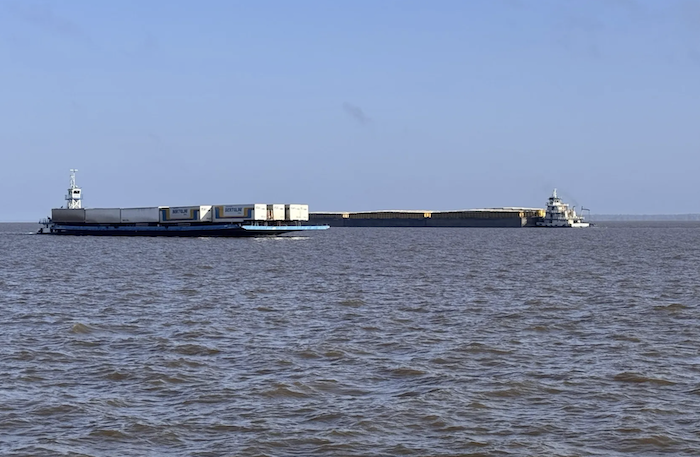
Ferries crisscross the river, and large freighters push their way through the muddy brown waters. In between, we zigzag through enormous fishing nets, which are repeatedly laid across the river. Sometimes the traffic feels almost like a road – only on a river, which in places is so wide that the opposite bank is barely visible. Even seemingly smaller tributaries turn out to be twice the width of the Danube.
The freighters are particularly impressive. They often appear slowly on the horizon and then draw closer until their true size becomes apparent. Many of them transport entire truckloads of barges in front of or behind them. In some sections, it feels like a freight train is traveling on the water.
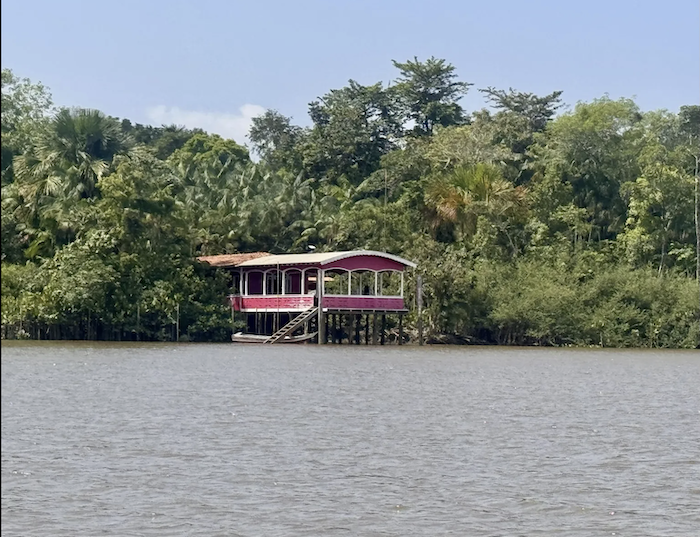
The riverbanks are surprisingly densely populated. Here and there, individual houses or small clusters of stilt houses stand directly on the water. Villages and towns lie scattered among them, along with countless small churches, and everywhere there is a lively atmosphere.
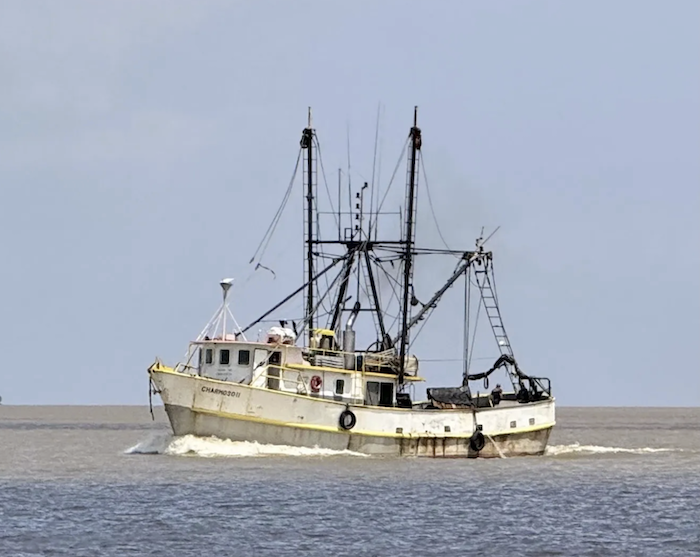
One of the most important sources of income for the people is the açaí palm. Its small, dark purple fruits grow in large bunches and are harvested and processed along the Amazon. What is usually known to us as a sweet açaí bowl is part of everyday life here and is often eaten quite differently, for example, with fish and cassava flour. Besides the açaí harvest, fishing is a particularly important livelihood for the people living along the river.
Motorcycle taxis are a common sight as soon as you go ashore. There are also countless small churches. Almost every village seems to have its own. Pets are also an integral part of life on the river. Ducks, pigs, dogs, and parrots run, swim, or sit around the houses and boats. The Amazon is not an uninhabited wilderness, but rather a habitat and transportation route for millions of people.
Varied riverbed
The riverbed is more varied than we expected. Depending on the section, the water depth ranges from approximately three to more than 20 meters and the current plays a crucial role in planning our day. It can vary between about 0.5 and 3 knots. With the current, you can make surprisingly good progress; against it, SV Infinity becomes a hard-working motorboat. Here and there, we’re even accompanied by river dolphins, which suddenly appear alongside the boat and disappear just as quickly back into the brown water.
Our daily routine is dictated by the current. We prefer to set off when the current is favorable, ideally at sunrise. This often gives us a tailwind until midday. The wind direction also follows a fairly typical pattern: in the morning, the wind has a slightly more northerly component, later becoming more easterly – but it almost always comes from the northeast. If the current shifts, we take a break. In this way, depending on the current and engine use, we cover about 20 to 40 nautical miles per day. The Amazon sets the rhythm. Those who accept it travel much more relaxed.
No Drug Smugglers, Pirates or Thunderstorms
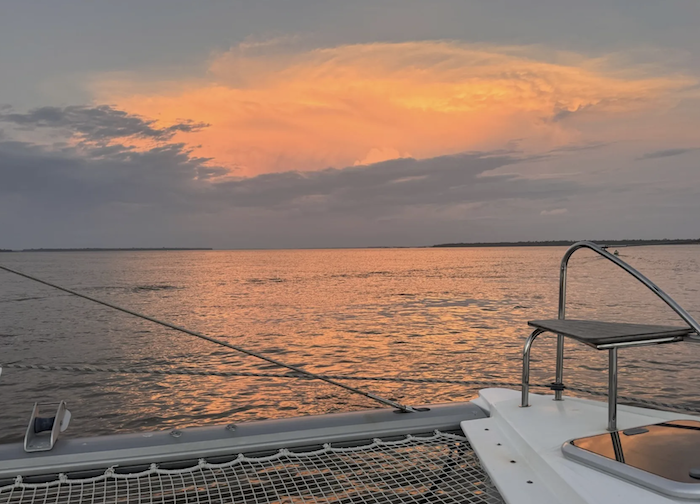
Another positive surprise is what we haven’t experienced. No drug smugglers, no pirates. No severe thunderstorms. Hardly any rain in August and no hordes of mosquitoes to make our lives miserable. Of course, we’ve still put up our mosquito net in the saloon, even though we’re not in a high-risk malaria area. There is crime, supposedly especially in the cities. But that doesn’t fundamentally distinguish the Amazon from many other regions of the world.
We hear about pirates and drug smugglers, but in person, we only meet friendly people. Pirates are supposedly looking for the thousands of liters of fuel carried by the freighters. As a sailboat, we can’t offer them that. We’re following a few simple recommendations. We’re only out during the day – both sailing and on foot. At night, we anchor near houses.
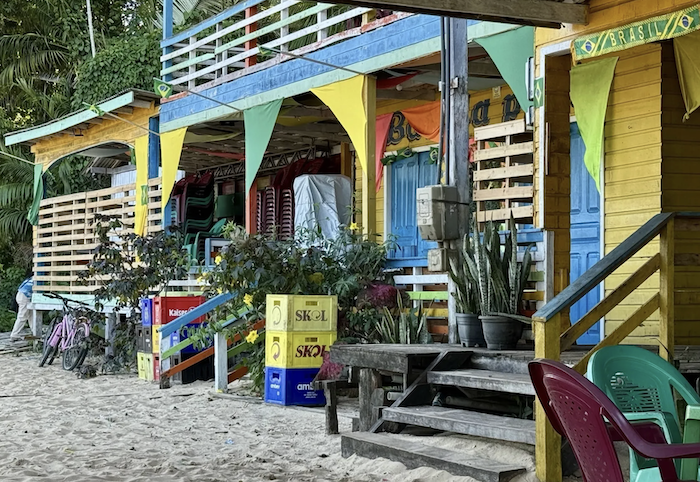
There, we deliberately seek contact with the people. A conversation, as far as that’s possible without extensive Portuguese skills and a few small gifts help us learn something about their lives. We stocked up on pens and paper for the children in Belém. And when people know who’s anchored in front of their house, they also look out for us. What goes around comes around in the rainforest. Sometimes, people come aboard quite naturally, without even asking.
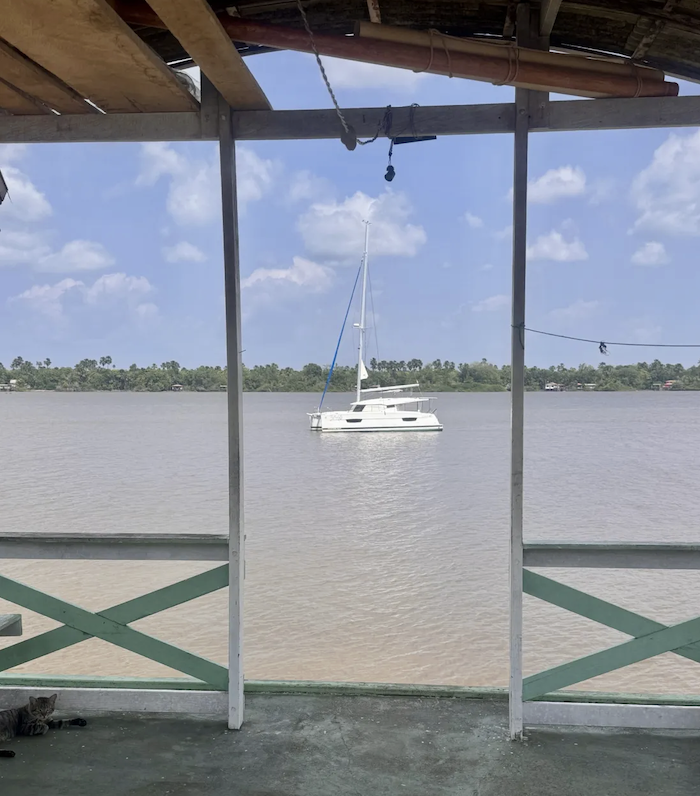
Poverty and Modernity
Often, they’re simply curious. Sometimes they want to see Infinity up close, sometimes just chat with us briefly. And some actually come aboard for a selfie – with the latest iPhone in hand and an expensive boat moored alongside us. That, too, is the Amazon: poverty and modernity, simple stilt houses and state-of-the-art smartphones, traditional ways of life and the global world exist side by side. You shouldn’t be surprised if a horde of children suddenly roars all over your boat. After all, we’re practically anchored in their front yard. For the people along the river, we and our sailboat are at least as exotic as their lives are for us. The curiosity goes both ways.
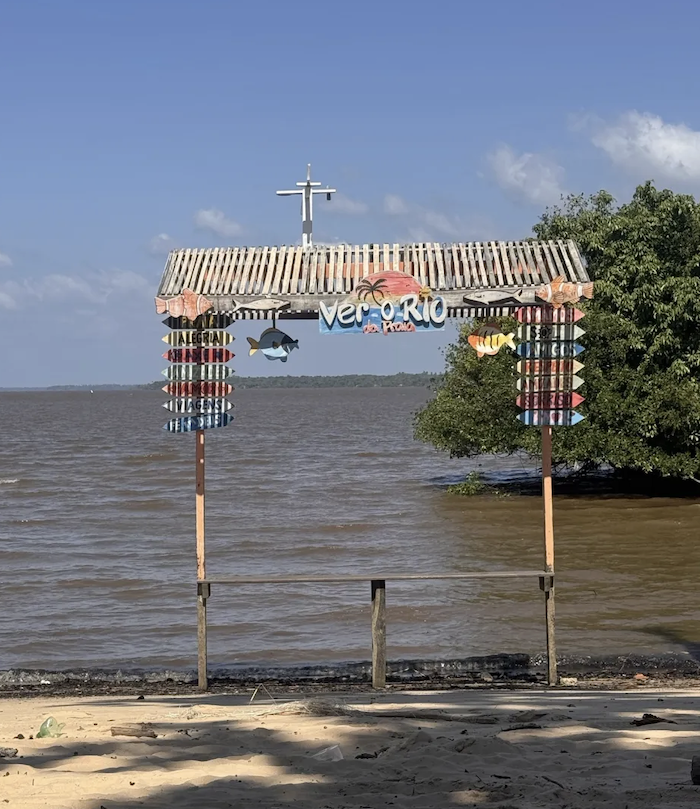
We often see people swimming in the water. It surprises us every time. The Amazon’s water, with its sediment-rich brown color, doesn’t seem particularly inviting. Furthermore, cities upstream, with their millions of inhabitants, lack adequate wastewater treatment. As visitors, it’s almost impossible for us to judge exactly what ends up in the river. However, the pollution of large rivers by wastewater and human activities is hardly a problem unique to the Amazon.
For us, the Amazon remains above all a journey through another world. Not through a deserted jungle, but through a landscape where nature and civilization seamlessly merge. Rainforest, houses on stilts, small villages, animals, freighters, fishermen, and Infinity all share the same river. 300 nautical miles through the Amazon Delta are not just a distance – they are 300 miles full of fascinating encounters.
Martin and Kerstin Giretzlehner
SV Infinity
……………………………………
Reprinted with Permission from Martin and Kerstin Giretzlehner.
……………………………………
About the Authors
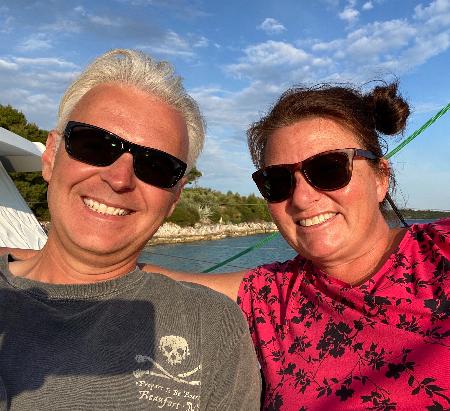 Austrian sailors Kerstin and Martin Giretzlehner fell in love with the sailing life after their first crewed charter in Croatia in 2011 and spent the next few years learning all they could while chartering in the Mediterranean and the Canary Islands. In 2020 they took the plunge, bought a catamaran and set off from Trogir, Croatia on their circumnavigation. Now in 2026, they are nearing the end of their circumnavigation as they approach the Caribbean.
- Read their Noonsite Portrait of a Cruiser
- Visit their website: Sailing Infinity
Read their other Reports for Noonsite:
……………………………………
© 2026 Noonsite. This content was edited by Noonsite. Do not reproduce without permission. All rights reserved.
The opinions expressed in this article and are the author’s own and do not reflect the view of Noonsite or World Cruising Club.
If you have found this information useful, become a paid member to enjoy unlimited use of Noonsite plus many other perks. Your membership fees really help our small, dedicated team keep country information up-to-date in support of cruisers worldwide. Find out more about Noonsite Membership levels and benefits here.
Subscribe to our FREE monthly newsletter: https://www.noonsite.com/newsletter/
Leave a comment
You must Login or Register to submit comments.