
Earth Sciences New Zealand Predicts Increased Tropical Cyclone Activity
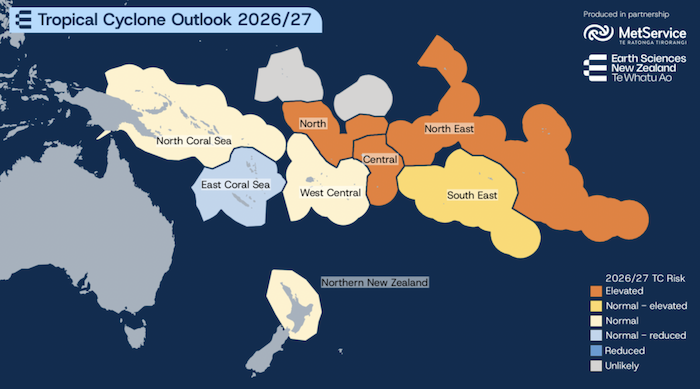
In their Tropical Cyclone Outlook for 2026/2027, scientists at Earth Sciences New Zealand (ESNZ) scientists are saying the Southwest Pacific could experience at least four severe tropical cyclones reaching category three or higher in the 2026/2027 Tropical Cyclone Season, which starts officially on November 1, 2026.
Tropical cyclones have a significant impact across the Southwest Pacific, with the season starting in November and lasting through to April. This coming season, significant differences are expected between the western and eastern parts of the region, with the risk of impacts expected to be higher near and to the east of the International Date Line.
Earth Sciences New Zealand’s Principal Scientist – Climate and Environmental Applications Dr Andrew Lorrey, says there are strong indications that the Southwest Pacific is likely to see an increase in cyclone activity relative to recent years.
“During past strong El Niño events like the one that’s currently unfolding, we’ve typically seen elevated numbers of cyclones across the region, along with more activity to the east of the International Date Line. This is an area that’s usually fairly quiet,” he said.
“Over the long term, cyclone numbers have been gradually decreasing in the Southwest Pacific, but there can be prominent year-to-year variability. Extended weather forecasts indicate we may also have an early start to the tropical cyclone season in the region this year,” says Dr Lorrey.
Fiji Meteorological Service Predicts Above Normal Activity
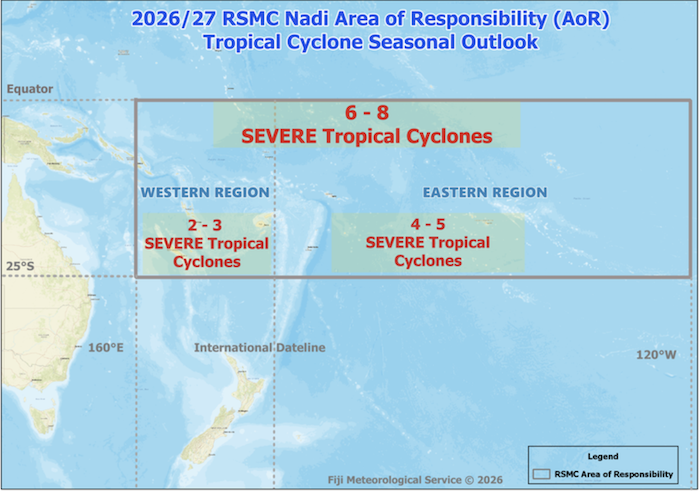
The Fiji Meteorological Service is predicting 11 to 15 Tropical Cyclones (TCs) likely in the Regional Specialized Meteorological Centre Nadi-Tropical Cyclone Centre Area of Responsibility (RSMC Nadi-TCC AoR) between November 2026 to April 2027.
On average, around seven TCs affect the RSMC Nadi-TCC AoR each season. This season is predicted to have above average TC activity. Key points from the FMS forecast:
- Two to three tropical cyclones are likely to pass through Fiji’s Exclusive Economic Zone during the 2026-27 tropical cyclone season.
- One to Two tropical cyclones are likely to reach severe category (Category 3-5) during the season.
- While the tropical cyclone season is between November to April, occasionally cyclones have formed in the region in October and May and rarely in September and June. Therefore, an out of season tropical cyclone activity cannot be ruled out.
- Tropical disturbances or depressions that do not attain TC intensity or low-pressure systems that are a result of decaying cyclone, can still cause widespread rainfall and potential flooding.
- Tropical Cyclone activities in the Pacific Island region are closely associated with the El Niño Southern Oscillation (ENSO), which is a fluctuation of oceanic and atmospheric condition between the eastern and western tropical Pacific Ocean.
- A strong El Niño event is firmly established in the tropical Pacific Ocean, with climate models favoring the event to develop to very strong intensity and persist through the remainder of 2026 and into early 2027.
…………………………………
Related News:
- NIWA New Zealand Southwest Pacific Tropical Cyclone
- Fiji Meteorological Service Tropical Cyclone Outlook 2026/2027
- Tropical Cyclone Wati Froms, Heads to Southern Cook Islands (WeatherWatch NZ)
…………………………………
Related Links
- Fiji Meteorological Service Tropical Warning Centre
- Cook Islands Metereological Service
- Joint Typhoon Warning Center
…………………………………
Noonsite has not independently verified this information.
…………………………………
If you have found this information useful, become a paid member to enjoy unlimited use of Noonsite plus many other perks. Your membership fees really help our small, dedicated team keep country information up-to-date in support of cruisers worldwide. Find out more about Noonsite Membership levels and benefits here.
Subscribe to our FREE monthly newsletter: https://www.noonsite.com/newsletter/
Leave a comment
You must Login or Register to submit comments.