
 Background
In 1974, the International Convention for the Safety of Life at Sea (SOLAS) (part of the International Maritime Organization (IMO) and the United Nations) specified the minimum standards for the construction, equipment, and operation of ships, compatible with their safety. Those requirements evolved into the Global Maritime Distress and Safety System (GMDSS) and were implemented in 1999. Communications equipment requirements were established by the International Telecommunications Union (ITU), also part of the United Nations.
The Federal Communications Commissions (FCC) has adopted the revisions and have included them within US type acceptance requirements for marine communications equipment. Over the years with changes in technology, the ITU has modified the GMDSS rules for communications.
VHF Radios
It was also mandated in 1999 that all new VHF radios must be Digital Selective Calling (DSC) capable and today a DSC radio is commonly recognized by the red distress button on marine VHF radios.
DSC provides one-button distress calling, Urgent, Safety, Routine, Group, and position reporting. A distress call from a DSC radio is digital and must be responded to by a shore station within 4.9 minutes. At 5 minutes, all vessels that received the distress call must complete a distress relay. While GMDSS utilizes many systems beyond the affordability of most cruisers, DSC radios are the only affordable link to the GMDSS system for the average cruiser.
HF SSB Radios
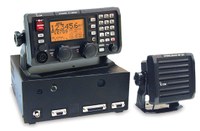
Several manufacturers also created High-Frequency Single Sideband (HF SSB) DSC radios. Most of the HF SSB DSC radios were very expensive (In the $3000.00 USD + price range), but Icom was able to provide an HF SSB radio in the $2000 USD price range, the IC M802. Over time the IC M802 dropped to under $2000. This made the IC M802 a reasonable investment for cruisers. As a result, an estimated 75% of cruisers heading south from the US and Canada have an IC M802 on board.
As the ITU has modified the required functionality of DSC radios, it has required manufacturers to modify the design of DSC capable radios.
The Icom IC M802 went through a catchup revision a few of years ago and met most of the new rules presented by the ITU. It is presently the only HF SSB radio available by Icom.
This past year the FCC did a review of the Icom radios and found that one of the older VHF radios and the IC M802 did not meet the latest requirements of the ITU. They directed Icom to update the radios.
Icom has stated that it would be a major revision to the IC M802 and would not be prudent to modify an old design radio to add new features and change timers. As a result, Icom is no longer selling the IC M802 to US retailers. Some of the retailers have existing stock and some are purchasing from Icom Canada. The IC M802 remains sold in all other countries in the world.
Part of Icom’s decision I believe was the fact they are designing a new GMDSS radio from the ground up. The new radio carries the model number GM 800. This radio is actually designed for more of a commercial use. It is designed to operate on 24 volts DC and has all the bells and whistles. It will be one of the finest GMDSS radios available and as you can imagine the cost will reflect the many features. A follow-on 12 volt DSC radio is planned, but many years out.
Some cruisers are moving toward the purchase of Amateur radios to fill the HF SSB void. This is unfortunate as Amateur radios are not made for boats, more difficult to operate than marine radios and most importantly does not provide a link into the GMDSS system.
Considerations for Cruisers
- DSC provides digital information that must be responded to in 5 minutes.
- EPIRB can take over 100 minutes just to get the signal to ground.
- VHF and HF SSB provide one to many communications.
- Voice communications may be difficult to understand and may have significant interference.
- Digital communications have a high probability for speed and accuracy.
- Inmarsat satellite phones are a very expensive option for cruisers
- No other satellite phone system ties into the GMDSS system which makes them a poor option for Safety Of Life At Sea.
For more information check my website on the IC M8002 page.
http://www.made-simplefor-cruisers.com/icm802
Stay Safe
Terry Sparks
CDR Retired
Leave a comment
You must Login or Register to submit comments.
Further Update:
Everything finally works to complete a response to the Icom M802 waiver.
Please spread the word. The FCC site is not very friendly.
Follow this and it should work:
1. Go To: http://www.fcc.gov/cgb/ecfs/
2. Select “Submit a Filing” at the top of the page
3. Select “Express Comments” on the second group at the top
4. In Proceedings type: 17-122 : Comment Sought on Icom MF/HF DSC Radio Waiver Request
5. Fill in your information
6. At the bottom paste any remarks (ideally write in word and copy and paste).
Be sure and copy to the printer:
Parties are requested to send one copy of their comments and reply comments to Best Copy and
Printing, Inc., Portals II, 445 12th Street, S.W., Room CY-B402, Washington, D.C. 20554,
(800) 378- 3160, e-mail FCC@BCPIWEB.com.
Update from Terry Sparks:
The FCC invited Icom to submit a waiver to allow the M802 not to be modified to meet the new GMDSS requirements. For those that may not be aware, while the new rules make some sense for commercial vessels, they would have almost no impact on cruisers. The M802 remains the only affordable Digital Select Calling (DSC) marine radio that will allow cruisers to directly contact commercial vessels. (Commercial vessels are only required to monitor/scan the emergency DSC channels, no voice monitoring is required for HF SSB)
Icom has submitted a waiver request to the FCC. The FCC is currently considering the waiver request and will respond. The FCC may put the waiver request out for public notice. I would hope that all cruisers would respond to the notice.
FYI, while the M802 costs around $1800, the next HF SSB DSC radio in order of cost is over $3200 making HF SSB DSC unaffordable for most cruisers.
Answer to one question is: It is presently legal for US cruisers to use an M802 radio. It is not legal for Icom America to sell new units to their distributors/resellers. In some cases, resellers are purchasing from Icom Canada.
Posted on behalf of John Proctor, S/V Tiata:
While I am aware of the problems with the M802 as it is not type approved in Australia there are also problems with the M801E which was a European approved model. That model was more expensive due to having a fully enclosed chassis and a switching regulator power supply for 12 VDC. That model was approved in Europe and also in Australia. However that model has fallen foul of the regulation changes in Europe and while still approved in Australia its days are numbered. Given ICOM’s stance it is clear they see a diminishing market for a recreational oriented HF marine radio. In reality I believe their view to be a correct one.
On the issue of DSC in HF I beg to differ with the author. In the HF part of the spectrum HF DSC has very real problems as out lined by this Maritime GMDSS Consultant: http://www.gmdss.com.au/flaws2.html . The reality is also that HF installations on cruising boats are a bit of a dog’s breakfast. As an Electronics Engineer and having done Marine Electronics professionally in my retirement (got to get my ration of hands on fixes) I can honestly say that too many installations are just plain badly done and very seldom maintained.
On the Amateur Radio side of things in today’s regulatory regimes most countries have a very relaxed amateur license class which mere mortals can obtain. Most Amateur Radio Clubs have introductory courses which will assist those whose technical abilities are not great obtain a license. The beauty of Amateur Radio is that there are many ears attached to real human beings listening at any point of time and a lot of information can be gained from various cruisers nets. The other advantage is that while not making you an expert in radio communications this service will provide a basic understanding of propagation, operating technique and introduce the holder to a much wider community.
If I were a lawyer which I am not I could say that using non-type approved radio equipment in the maritime spectrum context is illegal (except in the case of a genuine emergency at sea). This however ignores the fact that the regulatory regime in the case of Maritime HF radio has completely ignored the recreational mariner. They have done this by steadily revising equipment requirements upward which results in equipment that winds up pricing itself out of the recreational mariner’s pocketbook. We all do not own White Boats and have bottomless pits of money!
Regards,
John D Proctor B. Sc EE
S/V Tiata
VK2DLP