
Public Consultation Period until July 15, 2019:
Please send your statement/objection/opinion no later than July 15, 2019 at 4:15pm Panama time. Your statement must be on a PDF, JPEG or PNG document. This document can be e-mailed to:
customerelations@pancanal.com
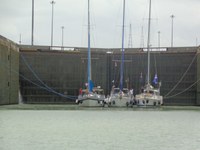
- Panama Canal
For the first time in seven years, the Panama Canal Authority (ACP) is proposing an increase in tolls for small craft. These modifications are to “take into account the costs, water used to lock these small vessels, and resources associated with the transit service as well as the complexity of accommodating these vessels in the Panamax locks chambers”.
Read the full proposal at https://tolls.panama-canal.com/pdf/Tolls-Proposal-FY2020.pdf.
CURRENT TOLLS:
- Less than 15.24m (50ft): $800
- 15.24m-24.384m (50-80ft): $1,300
- 24.384m-30.480m (80-100ft): $2,000
- More than 30.480m (100ft): $3,200
NEW TOLLS EFFECTIVE JANUARY 1, 2020:
- Less than 19.812m (65ft): $1,600
- 19.812m-24.384m (65-80ft): $2,400
- 24.384m-30.480m (80-100ft): $3,500
- More than 30.480m (100ft): $4,100
The public consultation period will extend until July 15, 2019 at 4.15pm local time. All are invited to participate in this process and in the public hearing scheduled for July 24, 2019.
Our thanks to Shelter Bay Marina for passing on this information.
Leave a comment
You must Login or Register to submit comments.
Unfortunately we have been cruising without internet since before this consultation was issued…and now we have internet but we have already missed the one month deadline. Presently in Vancouver Island after crossing north Pacific last year, and heading south…it was to Panama and the canal. Maybe not any more???
Well, since we last came through the canal in Dec 2012, which we thought expensive then, the crime in Central America has definitely increased, the charms of west caribbean have consequently diminished somewhat. Procrastination on whether to return through the canal or go via Magellan or even back across the Pacific to Asia again, and the long way home via South Africa just got a little more attractive. A 42 foot boat and we will pay the same as a 65 foot boat under the proposed rates.
Previously, we have transited part of the St Lawrence Seaway, that also has big commercial ships, it was set up so yachts do not need line handlers, nor advisers…much more efficient and not the same sense of being gouged for money.
Suggest the agents who service yachts might want to lobby on 24th July. Too late for our input.
Sue & Andy Warman
s/y Spruce
Bryn Chamberlain
1:43 PM (0 minutes ago)
to customerelations (Panama Canal)
I have read with considerable alarm the proposal to increase the tolls on the Panama Canal for small vessels (sailboats under 65′). The plan to double the current rate up to $1600 will have a negative effect on canal operations and yacht cruisers from both the Atlantic and Pacific Oceans. Having been part of the sailing communities on both the Caribbean and West Coast, I can confidently state that this proposal will have the opposite of the intended effect of generating revenue and sailboats of this size will simply not transit the canal.
To explain; yachts and pleasure craft of this size are often retirees or young families. The transit of the canal presents a welcome novelty and opportunity to experience the beauty of Panama. But is certainly not as an essential part of cruising and should not be categorized in the same manner as the commercial traffic that rely on the canal to do business. For commercial traffic, the canal fees are part of doing business. But for live-aboard sailors, cruising costs are of paramount importance. To double the fee to use the canal will force yachts to consider alternatives. And the alternatives are as varied as they are attractive; stay on the caribbean side and utilize the Windward, Leeward islands, and conversely stay on the Pacific side, cruising north or south on the west coast.
There is of course the argument that increasing the fee to cruising yachts is a necessity. But doubling the fee will reduce the number of smaller boats dramatically and greatly parse the tourism to Panama. The result would be a loss to both the sailors who would wish to visit Panama and those who depend on tourism dollars by offering logistic support.
I strongly recommend that the fee scheduled is reconsidered; reduced or at least implemented gradually rather that 100% all at one time.
Please send your statement/objection/opinion no later than July 15, 2019 at 4:15pm Panama time. Your statement must be on a PDF, JPEG or PNG document. This document can be e-mailed to:
customerelations@pancanal.com
Add: If you want to possibly influence the decision, formulate your comments and rationale and email them to: CustomerService@pancanal.com – there is a time limit to submit of 4:15 p.m. (local time) on July 15, 2019.
Corrected email, email comments to: customerelations@pancanal.com