
Different Groups of Cruising Sailors
The following recounts my impressions of cruising sailors which I have gained from reading about and meeting offshore cruisers. I have met cruising sailors while sailing myself and also while doing repairs on their boats when they were in New Zealand.
When I began offshore sailing, over 20 years ago, the people I met in the Pacific Islands were circumnavigators and couples or families who were long term (over five years) cruisers. The Australasians on the other hand were mostly on short term (four to month) holidays. I learnt the difference between long term cruising and just having lots of ocean miles.
Real Cruisers
I was on the sand bar off Musket Cove. It was my first offshore voyage in my own yacht. I was going to have logged 10,000 miles of open ocean sailing on this trip and considered myself to be an experienced sailor. I met an American on the sand bar who was exercising his two dogs. I asked if he was solo (apart from the dogs), he said no. His wife and family were taking a holiday back home in the USA. That in a nutshell is the distinction between cruisers and those of us who just sail a lot. They were in their tenth year. We were having a holiday cruising. They were real cruisers, who holidayed at home.
The proportions of different groups of sailors has changed. The circumnavigators who used to be about 30% of cruisers are now a very small proportion. Their total number has not changed, but they are now amongst a bigger group of people sailing offshore.
One Ocean Sailors
In addition to that – there are now “one ocean” sailors. Probably influenced by reports of kidnapping and crime, people are now sailing the Atlantic or sailing the Pacific. They will often buy a yacht at one side of an ocean and sail to the other side, then sell it. The Indian Ocean still remains a passage for the circumnavigators. However even that is changing because the Indian Ocean offers east to west in one season and west to east in another.
Watersport Enthusiasts
The last change is the arrival of watersport enthusiasts. These are surfers, kite boarders, divers and foiling board users who are travelling by yacht to exotic locations in order to experience their sport. I presume that makes a difference for them. Imagine kite boarding at North Minerva (half way between NZ and Fiji/Tonga), nearest land over 200 miles away. No land and not even a rock in sight at high tide. I saw that in 2015.
Other Big Changes
Overall the change has meant there is a smaller proportion of dedicated sailors. The ease with which people can navigate at sea, the constant presence of internet connections, the size and relative comfort of the yachts and the yachting support in remote locations have all contributed to offshore sailing being, just another travel option.
Another really big change is the presence of women. Women are now some of the most adventurous sailors. They have had a very significant influence on the type of yacht sailing. My opinion is that the predominance of catamarans in modern sailing has been influenced by female sailors. Similarly the size and comfort levels in modern yachts is likely attributable to female choices.
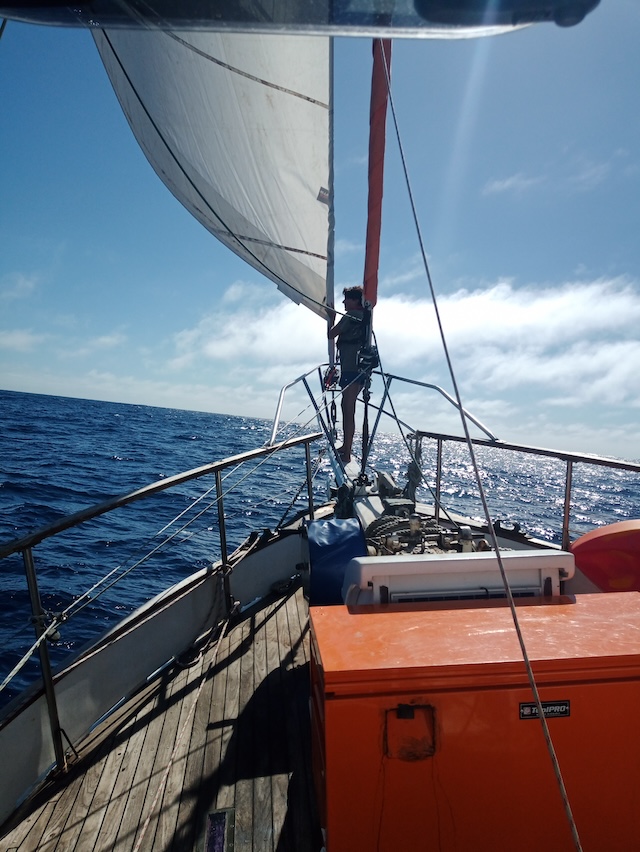
There is a characteristic about these new sailors which is interesting. They have little or no sailing skills. That is not a female characteristic it covers all sailors. Most sailors I meet today are totally dependent upon a GPS to tell them where to sail and an internet connection to give them a weather forecast.
I feel fortunate to have completed my Ocean Yacht Master certificate when celestial navigation was still taught. We used it on Westwind V in 2024. Lauren our crew member was taking daily noon sights and setting a course for the next 24 hours. She got it wrong only once. One day, after she set a course for California, I mentioned that it was not the way to Fiji and she recalculated.
I tried another navigation method just for fun. Zenith stars. However I was lost trying to identify individual stars and gave up completely on the way to Fiji, I did aim the yacht just east of the Pointers at 8pm each night on the way home. It sort of works but I was not confidant enough to pick Antares out of the Scorpio constellation. Antares is New Zealand’s zenith star.
Cruising Yachts
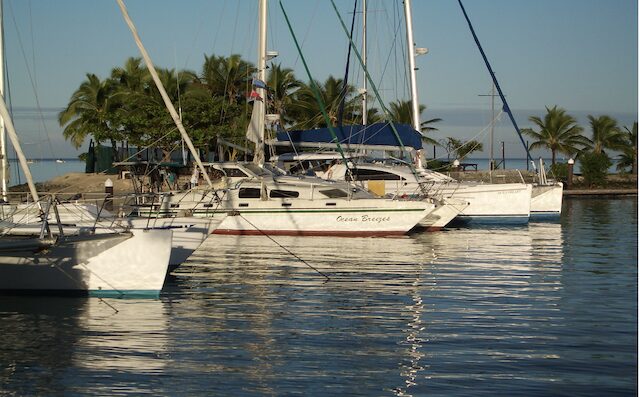
They are bigger. In 2003 the Farr 1340 yacht on which I was crew would have been about average size for the yachts sailing in Fiji. A later voyage, on an Adams 42, revealed this was now a bit on the small side. In 2011 my Prout Escale catamaran (39ft) was starting to look definitely small. In 2024 my 47ft, 30 tonne ketch looked small when compared to the modern 40 to 50 ft catamarans and 50 to 60 ft monohulls which were the new normal.
The big yachts are creating problems in various locations. The mooring field at Musket Cove seemed to have shrunk and the moorings were suddenly too close to each other. At Denarau they are encouraging yachts into berths at the piers and saying the moorings cannot take heavier yachts. There are cruising catamarans out there with displacements over 23 tonne (the weight of a Lagoon 450).
Navigation
As previously mentioned the GPS is king. Most especially the moving map GPS. New Zealand yachts are still required to carry charts but I wonder how many sailors would be able to plot a position and tomorrow’s course even with a GPS at hand.
Learning to use a moving map GPS is simple and instant. The control over zoom levels allows detail and the new windows feature on larger GPS screens means more than one zoom level can be used to both keep on course and identify hazards.
Where people will probably struggle is identifying map errors. In a region like Fiji there are frequent errors on both C-Map and Navionics. The radar overlay function can be used to correct some of this but not on all systems.
Weather
When I started we had this wonderful system of getting weather at sea. Weatherfax. It gave you a satellite map which covered most of the south west pacific in one picture. My first experience of this on a yacht was with an inexperienced navigator who was very concerned about lows and fronts sweeping across the ocean from Tasmania to New Zealand. We were over 1000 miles away just south of Fiji. I had to remind her to plot our yacht position before thinking about weather for the next 150 miles.
Interpreting weather fax was the issue. Bob Metcalf wrote a guide to tell us how to do that and gave good tips on how to pick up weather map errors. He started that explanation with the comment that weathermen are seldom wrong but their timing may be at fault. My first thought was that a forecast with timing errors is a forecast that is wrong. However he went on to explain that by tracking barometric pressure changes you could correct weather map positions and timing.
The really big improvement came with GRIB files. Someone else worked out wind and waves. You got more detailed information but you were one further step from the base data. What GRIB files needed of course was a means to receive them at sea. Forecasts were much like the pre weatherfax days when you departed with a three to four day forecast and then took whatever came.
Iridium phones and later Inmarsat BGAN connections gave us internet at sea and GRIB files on demand. However when the forecast did not match the conditions in front of you, there was not the old barometric correction system to fix things. That essentially remains the same today. The Iridium Go has become the mainstay for yachts which depend on GRIB files. These GRIB files come disguised as PredictWind or Windy forecasts.
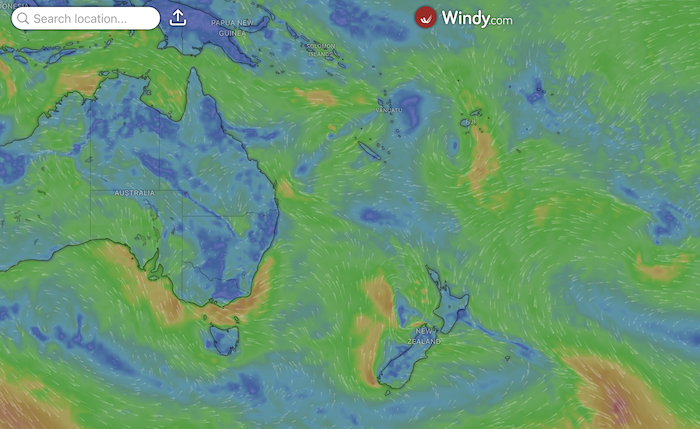
There is however another option seldom used by kiwi yachties. That is the passage or route planner. These take the weather out of your personal planning. Instead giving you a course to follow having already worked out if it fits your weather limits. This used to be an expensive service but with the arrival of options like “fastseas.com” this is now one of the cheapest ways to plan a passage, especially because the information can be received on devices like Garmin InReach.
Crew
We have been extremely lucky with crew choices on our offshore passages. Our first trip was planned with Tony McNeish, a very experienced sailor and former boat builder. In the week before leaving Wellington, Katey Matheson joined us. To this day she is probably technically the best sailor we have ever had on board our yachts.
After every one of her watches I found the yacht speed had increased. After every one of her watches I waited until she had left the cockpit and then slowed the yacht to reduce load on the rigging. She set up the sails so well I simply did not have the heart to ask her to stop.
In 2015 we met a yacht owner along our pier at Seaview Marina in Wellington, Mike Richards. After he joined us in Opua and we started sailing, we found that he had sailed across the Atlantic twice and sailed most of the east coast of Australia as well as having sailing holidays in the Mediterranean. There was a lot to learn from him but too little time. After reaching Tonga and Mike leaving us, we stumbled across Jian Xi Teng. He was hoping to find a passage to Fiji and we welcomed him aboard. It was only later we found out he had represented Singapore in international yacht racing.
As mentioned (in Part One – Reminisces on a Cruising Life) before we planned the trip with Lauren Donovan as crew. She had not said much about herself but had mentioned having sailed in the Caribbean and on the great lakes in USA. When we were arranging our Cat 1 we found she also had an Ocean Yacht Master Certificate and had crossed the Atlantic and sailed the Queensland Coast. Flora who we found wandering the docks at Opua had sailed across most of French Polynesia, but didn’t like to claim any experience. As inexperienced crew, you could not ask for better. She didn’t mind cooking and was ready to ask questions about anything that was beyond her experience. She paid attention to what was going on and always alerted us when needed.
There is still hope!
Looking back on the last 25 years there are several things I have learned. Most of all, yachts and sailing, especially offshore sailing, have made me a much poorer man, financially. I also know I never finished the plans I started. If I had been able to do more I would now be much poorer and much happier.
But I am not dead yet and I still own a yacht, so there is always hope.
John Manning
Kapiti, New Zealand.
…………………………………
Read Parts One and Two of John’s Essays:
- After the Sails are Furled: Part 1 – Last Offshore Passage
- After the Sails are Furled: Part 2 – Looking Back on 25 Years of Cruising
Related Reports:
South Pacific: Minerva Reefs worth more than just a stopover
…………………………………
© 2026 Noonsite. This content was edited by Noonsite. Do not reproduce without permission. All rights reserved.
The opinions expressed in this article are the author’s own and do not reflect the view of Noonsite.com or World Cruising Club.
If you have found this information useful, become a paid member to enjoy unlimited use of Noonsite plus many other perks. Your membership fees really help our small, dedicated team keep country information up-to-date in support of cruisers worldwide. Find out more about Noonsite Membership levels and benefits here.
Subscribe to our FREE monthly newsletter: https://www.noonsite.com/newsletter/
Leave a comment
You must Login or Register to submit comments.
Thanks John,
Very well said. Now at 73 and back last October from 6 months in the South Pacific, I can concur with almost everything you say…it’s not the same anymore…we’re getting old !
Cheers
Alan